Freshly Printed - allow 7 days lead
Couldn't load pickup availability
The Mediterranean Context of Early Greek History
“Drawing extensively on the latest archaeological data from the entire Mediterranean basin, Nancy Demand offers a compelling argument for situating the origins of the Greek city-state within a pan-Mediterranean network of maritime interactions that stretches back millennia.” – Jonathan Hall, University of Chicago
“Nancy Demand's book is a remarkable achievement. Her Heraklian labors have produced stunning documentation of the consequences of the vast spectrum of interaction between the peoples surrounding the Mediterranean Sea from the Mesolithic into the Iron Age.” – Carol Thomas, University of Washington
Nancy H. Demand (Author)
9781405155519, Wiley
Hardback, published 30 December 2011
384 pages
25.7 x 18 x 2.3 cm, 0.762 kg
“While the target audience may be that of the non-expert or undergraduate student, scholars, too, will find much in this book. Demand succeeds in making her Mediterranean truly a fantastic cauldron.” (Revue des Etudes Anciennes, 1 December 2012) “For these reasons, and despite its shortcomings, the book is worth reading and the author should be praised for bringing together a vast body of complex data with knowledge and erudition.” (The Anglo-Hellenic Review, 1 October 2012)
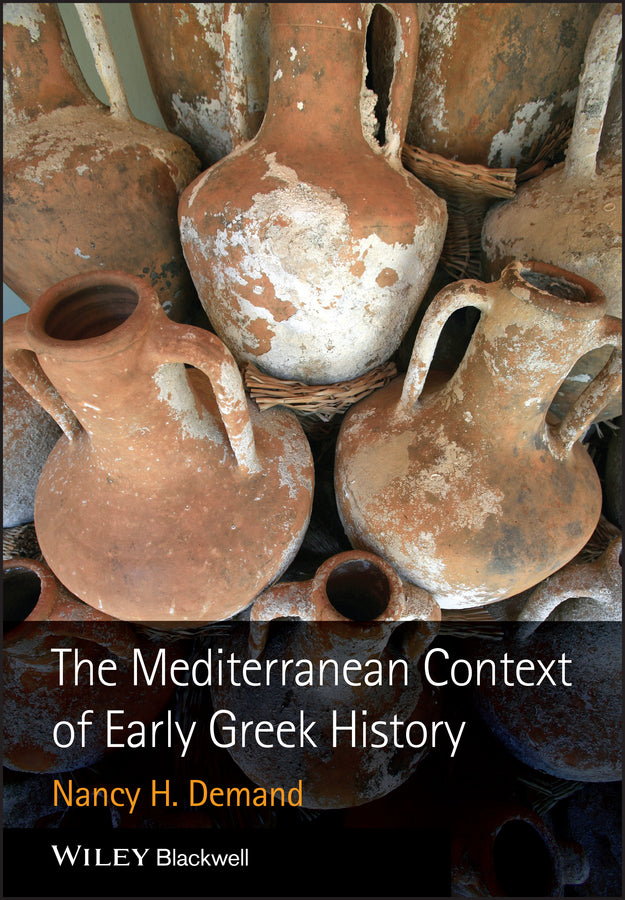
The Mediterranean Context of Early Greek History p>“Drawing extensively on the latest archaeological data from the entire Mediterranean basin, Nancy Demand offers a compelling argument for situating the origins of the Greek city-state within a pan-Mediterranean network of maritime interactions that stretches back millennia.” Jonathan Hall, University of Chicago “Nancy Demand’s book is a remarkable achievement. Her Heraklian labors have produced stunning documentation of the consequences of the vast spectrum of interaction between the peoples surrounding the Mediterranean Sea from the Mesolithic into the Iron Age.” Carol Thomas, University of Washington Were the origins of the Greek city-state – the polis – a unique creation of Greek genius? Or did their roots extend much deeper? Noted historian Nancy H. Demand joins the growing group of scholars and historians who have abandoned traditional isolationist models of the development of the Greek polis and cast their scholarly gaze seaward, to the sparkling waters of the Mediterranean. The Mediterranean Context of Early Greek History reveals the role the complex interaction of Mediterranean cultures and maritime connections had in shaping and developing urbanization, including the ancient Greek city-states. Utilizing, and enhancing upon, the model of the “fantastic cauldron” first put forth by Jean-Paul Morel in 1983, Demand reveals how Greek city-states did not simply emerge in isolation in remote country villages, but rather, sprang up along the shores of the Mediterranean in an intricate maritime network of Greeks and non-Greeks alike. We learn how early seafaring trade, such as the development of obsidian trade in the Aegean, stimulated innovations in the provision of food (the Neolithic Revolution), settlement organization (“political form”), materials for tool production, and concepts of divinity. With deep scholarly precision, The Mediterranean Context of Early Greek History offers fascinating insights into the wider context of the Greek city-state in the ancient world.
List of Illustrations vii List of Abbreviations ix Introduction: the “fantastic Cauldron” of the Mediterranean Koine xi 1 Seafaring in the Mesolithic Mediterranean 1 2 The Neolithic Revolution/Transition 13 3 The Neolithic Diaspora 35 4 Urbanization in Mesopotamia 60 5 The Third Millennium 83 6 The Middle Bronze Age (2000–1550 BC): Recoveries 126 7 Late Bronze Age Maritime Networks 162 8 The Late Bronze Age Collapse and its Aftermath 193 9 Recovery and Expansion (1050–850 BC) 220 Bibliography 256 Index 349
Subject Areas: History [HB]