Freshly Printed - allow 10 days lead
Couldn't load pickup availability
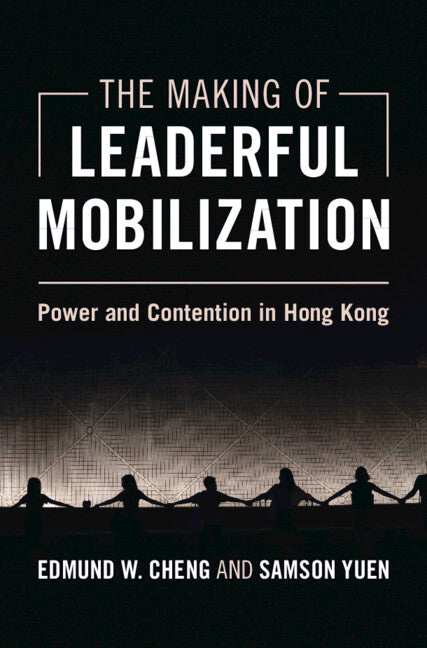
The Making of Leaderful Mobilization
Power and Contention in Hong Kong
Establishes a new theory on the declining role of movement organizations and the rise of leaderful mobilization in Hong Kong.
Edmund W. Cheng (Author), Samson Yuen (Author)
9781009445856, Cambridge University Press
Hardback, published 6 February 2025
310 pages
22.9 x 15.2 x 2.1 cm, 0.56 kg
'… indispensable for anyone seeking to understand not only the 2019 Hong Kong protest but also the broader dynamics of contentious politics, political mobilization and state-society relations under hybrid regimes.' Ray Yep, The China Quarterly
The past few decades saw the transformation of Hong Kong from a liberal enclave to a revolutionary crucible at China's offshore. The Making of Leaderful Mobilization takes you through the evolution of protests in this restive city, where ordinary citizens gradually emerged as the protagonists of contention in place of social movement organizations. The book presents a theory of mediated threat that illuminates how threat perceptions fueled shifting forms of mobilization – from brokered mobilization where organizations played guiding roles to leaderful mobilization driven by peer collaboration among the masses. Bringing together event analysis, opinion polls, interviews, and social media data, this book provides a thorough and methodical anatomy of Hong Kong's contentious politics. It unveils the processes and mechanisms of collective action that likely prevailed in many contemporary social movements worldwide. Our temporal approach also uncovers the multiple pathways reshaping hybrid regimes, underscoring their resilience and fragility.
1. Introduction
Part I. Context: 2. The making of a liberal oligarchy
3. A new cycle of protests
Part II. Episodes: 4. No leaders, only the masses
5. Synchronizing threats
Part III. Mechanisms: 6. Sectoral networks
7. Loss of innocence
8. Peer collaboration
9. Money matters
10. Radicalization and solidarity
11. Conclusion.
Subject Areas: Sociology [JHB]