Freshly Printed - allow 10 days lead
Couldn't load pickup availability
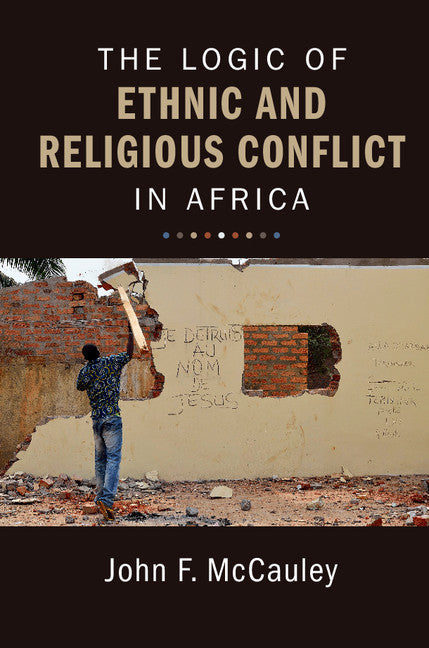
The Logic of Ethnic and Religious Conflict in Africa
This book explains why conflicts in Africa are sometimes ethnic and sometimes religious, even when the opponents remained unchanged.
John F. McCauley (Author)
9781316626801, Cambridge University Press
Paperback / softback, published 27 April 2017
248 pages
22.7 x 15.1 x 1.5 cm, 0.37 kg
'Overall, this book presents the fruit of an innovative research design with which McCauley develops what I firmly believe is a sound theoretical model for examining and understanding a complex mechanism of social mobilization; namely, how political elites manipulate the general population. Furthermore, by illuminating how social identity types produce unique sets of individual-level preferences and attitudes, the book's novel perspective proves useful for distinguishing and analysing different forms of identity group competition (religious politics, ethnic politics and gender politics) with greater clarity than previously possible.' Ibrahim Can Sezgin, African Affairs
This book explains why conflicts in Africa are sometimes ethnic and sometimes religious, and why a conflict might change from ethnic to religious even as the opponents remain fixed. Conflicts in the region are often viewed as either 'tribal' or 'Muslim-Christian', seemingly rooted in deep-seated ethnic or religious hatreds. Yet, as this book explains, those labels emerge as a function of political mobilization. It argues that ethnicity and religion inspire distinct passions among individuals, and that political leaders exploit those passions to achieve their own strategic goals when the institutions of the state break down. To support this argument, the book relies on a novel experiment conducted in Côte d'Ivoire and Ghana to demonstrate that individual preferences change in ethnic and religious contexts. It then uses case illustrations from Côte d'Ivoire, Nigeria, and Sudan to highlight the strategic choices of leaders that ultimately shape the frames of conflict.
Part I: 1. Introduction
2. A theory of mobilization differences in identity types
3. Evidence from Côte d'Ivoire and Ghana
4. Observable implications
Part II: 5. Theory of political choice
6. Ethnic and religious identity in Côte d'Ivoire's conflict
7. Ethnicity and religion in Sudan's civil wars
8. Ethnicity and religion in Nigeria's Biafran war
9. Conclusion
Appendices
Bibliography
Index.
Subject Areas: Comparative politics [JPB]