Freshly Printed - allow 10 days lead
Couldn't load pickup availability
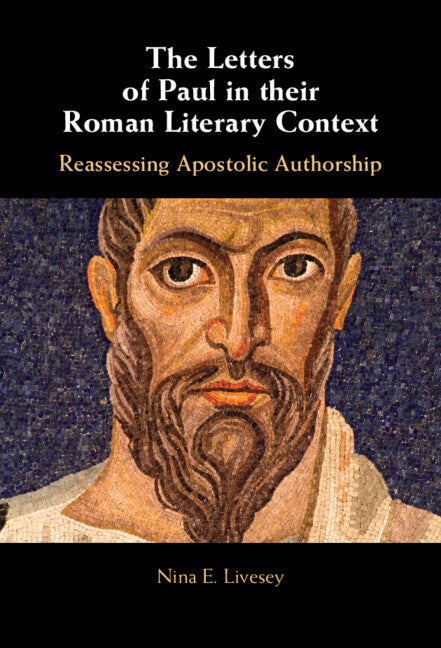
The Letters of Paul in their Roman Literary Context
Reassessing Apostolic Authorship
This study argues that the seven letters of Paul, widely assumed as authentic, should be reclassified as pseudonymous.
Nina E. Livesey (Author)
9781009487054, Cambridge University Press
Hardback, published 12 December 2024
346 pages
23.6 x 16 x 2.6 cm, 0.678 kg
'Recommended.' J. P. Blosser, Choice
Since the late-nineteenth century, scholars have all but concluded that the Apostle Paul authored six authentic community letters (Romans, 1 and 2 Corinthians, Galatians, Philippians, and 1 Thessalonian) and one individual letter to Philemon. In this book, by contrast, Nina E. Livesey argues that this long-held interpretation has been inadequately substantiated and theorized. In her groundbreaking study, Livesey reassesses the authentic perspective and, based on her research, reclassifies the letters as pseudonymous and letters-in-form-only. Like Seneca with his Moral Epistles, authors of Pauline letters extensively exploited the letter genre for its many rhetorical benefits to promote disciplinary teachings. Based on the types of issues addressed and the earliest known evidence of a collection, Livesey dates the letters' emergence to the mid-second century and the Roman school of Marcion. Her study significantly revises the understanding of Christian letters and conceptions of early Christianity, as it likewise reflects the benefit of cross-disciplinarity.
Introduction: challenging a prevailing paradigm
1. The press toward the authentic-letter perspective
2. Paul, pauline communities, and genuine correspondence
3. Seneca's moral epistles and pauline letters as teachings
4. Pauline letters as second century school-setting compositions
Epilogue
Appendix
Bibliography
Index.
Subject Areas: Biblical studies & exegesis [HRCG]