Freshly Printed - allow 8 days lead
Couldn't load pickup availability
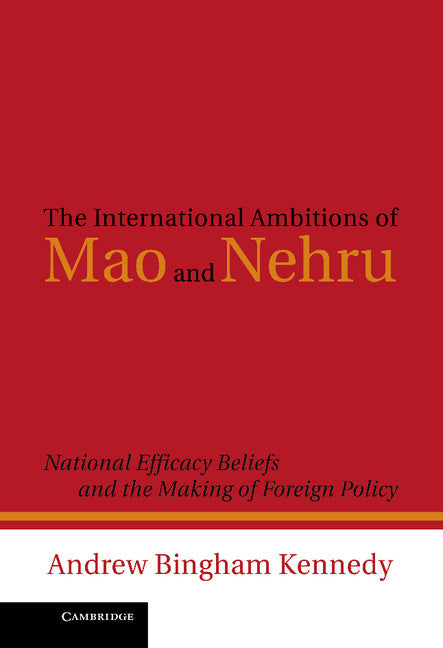
The International Ambitions of Mao and Nehru
National Efficacy Beliefs and the Making of Foreign Policy
This book explains the dramatically different foreign policies adopted by China under Mao Zedong and by India under Jawaharlal Nehru.
Andrew Kennedy (Author)
9780521193511, Cambridge University Press
Hardback, published 29 December 2011
272 pages, 3 b/w illus. 3 maps
23.4 x 15.6 x 1.6 cm, 0.56 kg
“Kennedy is theoretically innovative and provides rich and detailed case studies based upon research in India, China, the United Kingdom, and the United States. His in-depth cases cannot be ignored by any scholar trying to understand Chinese and Indian foreign policy behavior under Mao and Nehru, respectively.” -Manjeet S. Pardesi, Indiana University, Perspectives on Politics
Why do leaders sometimes challenge, rather than accept, the international structures that surround their states? In The International Ambitions of Mao and Nehru, Andrew Kennedy answers this question through in-depth studies of Chinese foreign policy under Mao Zedong and Indian foreign policy under Jawaharlal Nehru. Drawing on international relations theory and psychological research, Kennedy offers a new theoretical explanation for bold leadership in foreign policy, one that stresses the beliefs that leaders develop about the 'national efficacy' of their states. He shows how this approach illuminates several of Mao and Nehru's most important military and diplomatic decisions, drawing on archival evidence and primary source materials from China, India, the United States and the United Kingdom. A rare blend of theoretical innovation and historical scholarship, The International Ambitions of Mao and Nehru is a fascinating portrait of how foreign policy decisions are made.
1. Introduction
2. National efficacy beliefs and foreign policy
Part I. Mao's China: 3. Same revolution, different dreams
4. Mao's adventure in Korea
5. Persistent pugnacity
Part II. Nehru's India: 6. Gandhi's dissimilar disciples
7. Nehru's misstep in Kashmir
8. Determined diplomacy
9. Conclusion.
Subject Areas: International relations [JPS], Comparative politics [JPB]