Freshly Printed - allow 10 days lead
Couldn't load pickup availability
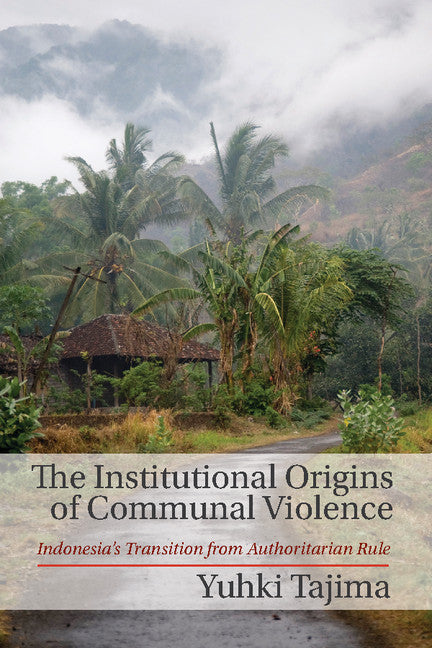
The Institutional Origins of Communal Violence
Indonesia's Transition from Authoritarian Rule
This book develops a novel theoretical explanation for why transitions from authoritarian rule are often marked by spikes in communal violence.
Yuhki Tajima (Author)
9781107028135, Cambridge University Press
Hardback, published 28 July 2014
224 pages, 3 b/w illus. 3 maps 11 tables
23.5 x 15.6 x 1.8 cm, 0.46 kg
'Tajima argues that 'mismatches between formal and informal institutions' explain violent conflict in post-New Order Indonesia. …The book offers a useful contribution by drawing attention to the importance of non-state, local forms of policing and conflict prevention that have been effective at preventing violence in the absence of state enforcement.' Jacques Bertrand, Bulletin of Indonesian Economic Studies
Why are transitions from authoritarian rule often marked by spikes in communal violence? Through examining Indonesia's recent transition to democracy, this book develops a novel theoretical explanation for this phenomenon that also accounts for why some communities are vulnerable to violence during such transitions while others are able to maintain order. Yuhki Tajima argues that repressive intervention by security forces in Indonesia during the authoritarian period rendered some communities dependent on the state to maintain intercommunal security, whereas communities with a more tenuous exposure to the state developed their own informal institutions to maintain security. As the coercive grip of the authoritarian regime loosened, communities that were more accustomed to state intervention were more vulnerable to spikes in communal violence until they developed informal institutions that were better adapted for less state intervention. To test the theory, Tajima employs extensive fieldwork in, and rigorous statistical evidence from, Indonesia as well as cross-national data.
1. Introduction
2. An institutional theory of intercommunal order and violence
3. Building and constraining the Indonesian state
4. The problem of local order: a view from the kampung
5. A microstatistical test of the theory
6. Small-scale communal conflicts: Lampung Province
7. Outbreaks of large-scale communal conflicts
8. The theory in comparative perspective
9. Conclusion.
Subject Areas: Comparative politics [JPB], Politics & government [JP], Sociology [JHB]