Freshly Printed - allow 10 days lead
Couldn't load pickup availability
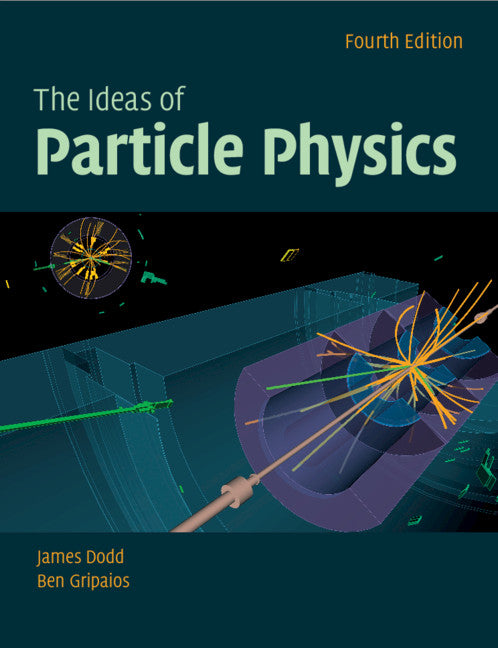
The Ideas of Particle Physics
The fourth edition of this popular book is a comprehensive introduction to particle physics, including the latest ideas and discoveries.
James E. Dodd (Author), Ben Gripaios (Author)
9781108727402, Cambridge University Press
Paperback / softback, published 24 September 2020
328 pages, 171 b/w illus.
24.4 x 18.9 x 1.5 cm, 0.72 kg
'… The Ideas of Particle Physics remains an excellent book, predominantly aimed at graduate students, as a complement to courses and other reference works.' Dave Barney, CERN Courier
This book is a comprehensive introduction to particle physics, bridging the gap between traditional textbooks on the subject and popular accounts that assume little background knowledge. This fourth edition is fully revised, including the most recent ideas and discoveries, and the latest avenues of research. The development of the subject is traced from the foundations of quantum mechanics and relativity, through the formulation of quantum field theories, to the standard model. Research now continues with the first signs of physics beyond the standard model and with the formulation of modern string theory which aims to include a quantum theory of gravity for the first time. This book is intended for anyone with a background in physical sciences who wishes to learn about particle physics. It is also valuable to students of physics wishing to gain an introductory overview of the subject.
Preface
Part I. Introduction: 1. Matter and light
2. Special relativity
3. Quantum mechanics
4. Relativistic quantum theory
Part II. Basic Particle Physics: 5. The fundamental forces
6. Symmetry in the microworld
7. Mesons
8. Strange particles
Part III. Strong Interaction Physics: 9. Resonance particles
10. SU(3) and quarks
Part IV. Weak Interaction Physics I: 11. The violation of parity
12. Fermi's theory of the weak interactions
13. Two neutrinos
14. Neutral kaons and CP violation
Part V. Weak Interaction Physics II: 15. The current-current theory of the weak interactions
16. An example leptonic process: electron-neutrino scattering
17. The weak interactions of hadrons
18. The W boson
Part VI. Gauge Theory of the Weak Interactions: 19. Motivation for the theory
20. Gauge theory
21. Spontaneous symmetry breaking
22. The Glashow–Weinberg–Salam model
23. Consequences of the model
24. The hunt for the W±, Z0 bosons
Part VII. Deep Inelastic Scattering: 25. Deep inelastic processes
26. Electron-nucleon scattering
27. The deep inelastic microscope
28. Neutrino-nucleon scattering
29. The quark model of the structure functions
Part VIII. Quantum Chromodynamics – The Theory of Quarks: 30. Coloured quarks
31. Colour gauge theory
32. Asymptotic freedom
33. Quark confinement
Part IX. Electron-Positron Collisions: 34. Probing the vacuum
35. Quarks and charm
36. Another generation
Part X. The Standard Model: 37. The model in summary
38. Precision tests of the model
39. Flavour Mixing and CP violation
40. The Large Hadron Collider
41. Discovery and properties of the Higgs boson
Part XI. Beyond the Standard Model: 42. Reasons to go beyond
43. Neutrino masses and mixing
44. Grand unification
45. Supersymmetry
46. Composite Higgs models
47. Axions and the Strong CP problem
Part XII. Particle Physics and Cosmology: 48. The big bang and inflation
49. The cosmic microwave background
50. The matter-anti-matter asymmetry
51. Dark matter
52. Dark energy
Part XIII. Gravity and Gravitational Waves: 53. From general relativity to gravitational waves
54. The discovery of gravitational waves
55. Gravitational wave and multi-messenger astronomy
56. The future: Super Ligo and LISA
Part XIV. String Theory: 57. Origins – the hadronic string
58. String theory to M-theory
59. The AdS-CFT correspondence
60. Consequences of the theory
Part XV. The Future – To Boldly Go!: 61. Accelerators, observatories and other experiments
62. Known unknowns
63. Glittering prizes
64. Unknown unknowns: it must be beautiful
Appendices: 1. Units and constants
2. Glossary
3. List of symbols
4. Bibliography
5. Elementary particles data
Name index
Subject index.
Subject Areas: Particle & high-energy physics [PHP], Physics [PH]