Freshly Printed - allow 8 days lead
Couldn't load pickup availability
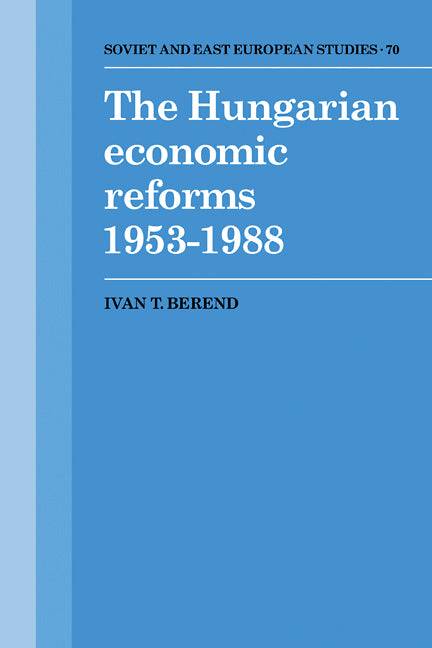
The Hungarian Economic Reforms 1953–1988
Professor Berend presents a comprehensive inside account of Hungary's economic reforms since the 1950s.
Ivan T. Berend (Author)
9780521108010, Cambridge University Press
Paperback / softback, published 12 February 2009
360 pages
22.9 x 15.2 x 2 cm, 0.53 kg
Professor Berend presents a comprehensive inside account of Hungary's economic reforms since the 1950s. Working from Communist Party archives, which have hitherto partially remained closed to scholars, Berend situates the history of these economic reforms within their political context, looking in particular at the role of the Soviet Union. He examines the theoretical background to reform, the obstacles that arose during implementation and the gradual realisation that minor reforms of the old system could no longer work. The Hungarian Economic Reforms 1953–1988 comes at a time when many centrally planned economies are examining their performance and structure and seeking suitable forms of change. The Hungarian reforms have attracted those countries wishing to rid themselves of their Stalinist command economies. Thus the book indirectly sheds light upon Chinese economic reforms and on Gorbachev's Soviet perestroika. It will be of interest to specialists and students of East European studies, with special reference to the EMEA, planned economies and economic reform.
Preface
Introduction
Part I. The First Phase of the Reform Process: the intellectual antecedents and the first corrective steps, 1953–1964: 1. The first moves to correct the economic mechanism
2. The critique of the command economy: towards a new concept of the economic system
3. The turn: reforms goals of the government and the practice of correction
4. Economic reform and the workers' councils
5. The principle of the substantial reform
6. A counterproposal for partial corrective measures
7. Immediate corrections to the operation of the economy
8. Intervention against the comprehensive reform plans as 'economic revisionism'
9. Minor corrections - the transformation of company structures
11. The new model for agricultural cooperatives
12. First criticisms of the ineffectiveness of the corrective policy
Part II. The 1966 decision on comprehensive reform: the second phase: 13. Disequilibrium, tensions and shortcomings in the workings of the economy
14. Plans and preparation for reform in other socialist countries
15. The political background to the reform
16. The reform decision
17. Debates on the reform and compromises before its introduction
18. The main features of the new reform system
19. The plan and preparations for continuing the reform after 1968
20. The reform comes to a halt and reversal
21. The oil crisis and its consequences
Part III. The Third Phase of the Reform Process, from 1979 onwards: 22. Changing political conditions
23. Returning to reform
24. A new chapter in the debates on reform: the reform decisions of 1984 and 1987
25. The price reform of 1979–1980
26. Partial reform of the system of institutions
27. Internal contradictions and delays in the process of reform
28. A new role for small business
29. From reform towards a change of system
Notes
Index.
Subject Areas: Macroeconomics [KCB]