Freshly Printed - allow 10 days lead
Couldn't load pickup availability
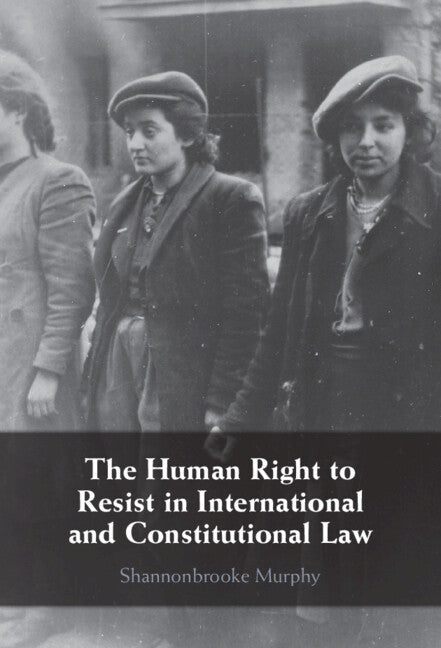
The Human Right to Resist in International and Constitutional Law
Provides the first comprehensive introduction to the concept of the human right to resist and its status in positive law.
Shannonbrooke Murphy (Author)
9781108838214, Cambridge University Press
Hardback, published 27 February 2025
376 pages
23.5 x 15.9 x 2.5 cm, 0.68 kg
'… an excellent new addition to theoretical and doctrinal legal scholarship, undoubtedly breaking new ground. It more than lives up to its objective of bringing the right to resist 'in from the margins'. In these troubled and troubling times, it makes an invaluable contribution to the clarification of what individuals and groups may lawfully do to resist power. This book will certainly undergird various new inquiries on the right to resist.' Natalie Jones, European Journal of International Law
The human right to resist is a contemporary legal concept with an ancient pedigree. Although it has received recognition in constitutions, customary international law and human rights treaties, and acknowledgment by leading publicists of international law, it remains obscure compared to other human rights. In this innovative and comprehensive book, Shannonbrooke Murphy addresses the perennial question of who has a 'right' to resist – and what, when, why, and how, from a legal perspective. Using a systematic and comparative approach to analyzing both the theoretical concept and the provisions in positive law, this study aims to establish that a 'right to resist' can be recognized and codified as an enforceable 'human right', proposing a common conceptual language and an analytical framework for evaluating the legal basis of claims. Murphy makes a strong and detailed case for a firmer place for the 'right to resist' in the human rights lexicon.
1. Introduction: in from the margins
Part I. The Concept: 2. Advancing a legal definition of the right
3. Clarifying the nature and legal function of the right
4. Identifying the elements and legal content of the right
Part II. The Law: 5. Domestic provision in constitutional law
6. Recognition in general or customary international law
7. Provision in treaty law and other international codification
8. Conclusions and an agenda for reconsideration
Bibliography
Index.
Subject Areas: Human rights & civil liberties law [LNDC]