Freshly Printed - allow 10 days lead
Couldn't load pickup availability
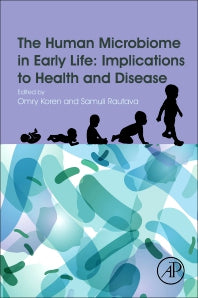
The Human Microbiome in Early Life
Implications to Health and Disease
Comprehensive work on the current state of knowledge of the origins and composition of the early life microbiome and its relation to health and disease
Omry Koren (Edited by), Samuli Rautava (Edited by)
9780128180976, Elsevier Science
Paperback, published 18 September 2020
326 pages, 70 illustrations (50 in full color)
22.9 x 15.1 x 2.1 cm, 0.52 kg
The Human Microbiome in Early Life: Implications to Health and Disease presents recent research advances that have highlighted the significance of early life, possibly beginning before birth, in the establishment of both the microbiome and its role in health and disease. The book reviews current knowledge on the origins of the human microbiota in early life, presents exposures which may disturb normal microbial colonization, and covers their implications to the risk of disease. Finally, emerging means to modify the early human microbiome to improve health are discussed.
I. PREGNANCY AND FETAL LIFE 1. The microbiome in a healthy pregnancy 2. The microbiome and pregnancy complications 3. Microbial signatures of preterm birth 4. Prenatal origins of the infant gut microbiome II. BIRTH - ENTERING THE WORLD DOMINATED BY MICROBES 5. Mode of delivery, the infant microbiome, and the risk of disease 6. Early-life antibiotic exposure, the gut microbiome, and disease in later life 7. The intestinal microbiome of preterm infants III. INFANCY - ESTABLISHMENT OF THE MICROBIOME AND HEALTHY DEVELOPMENT 8. The compositional development of the microbiome in early life 9. Microbes, human milk, and prebiotics 10. The early gut microbiome and the risk of chronic disease IV. MODIFYING EARLY MICROBIAL CONTACT 11. Postbiotics: defining the impact of inactivated microbes and their metabolites on promotion of health 12. Modification of the gut microbiome in an attempt to reduce the risk of child disease: clinical data from prenatal interventions 13. Clinical data from postnatal interventions
Subject Areas: Microbiology [non-medical PSG]