Freshly Printed - allow 10 days lead
Couldn't load pickup availability
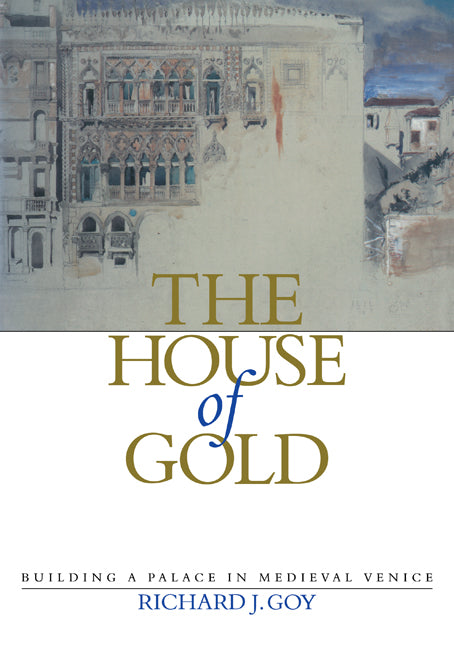
The House of Gold
Building a Palace in Medieval Venice
This 1993 book tells the history of the building of the Cà d'Oro, or 'House of Gold', over a period of nearly twenty years.
Richard J. Goy (Author)
9780521181341, Cambridge University Press
Paperback / softback, published 17 February 2011
338 pages
25.4 x 17.8 x 1.8 cm, 0.59 kg
In 1406 a young Venetian nobleman, Marin Contarini, married into another ancient patrician clan. His wife's family owned an old palace on the Grand Canal. Contarini demolished the old palace and, in 1421, he began to build the Cà d'Oro, his 'House of Gold'. This 1993 book tells the history of the building of the palace over a period of nearly twenty years. After a general introduction to the city of Venice at the beginning of the quattrocento, Dr Goy discusses the background to the building of the palace. There follows a discussion of the building industry in Venice in this flourishing period, and of the functions of the three chief building crafts. In the latter half of the study, the whole building process is recreated in detail; the relationships between Contarini and his craftsmen are analysed, as is the pivotal role of Contarini himself, the architect manqué whose monument this was to become.
List of illustrations
Preface
Acknowledgements
Glossary of terms
Sources and methodology
General introduction
Part I. Venice in the Early Quattrocento: 1. The economic and political background
2. The city in 1400
3. The medieval Venetian palace
Part II. The Contarini Casada: 4. The Contarini: a great patrician clan
5. Marin and his marriage
6. Antonio Contarini, an ambitious father
7. Contarini's business activities
8. A domestic interlude: family and servants 1426–1430
9. The new palace at Santa Sofia: motives and methods
10. First impressions: the plan, structure and appearance of the palace
Part III. Building in Medieval Venice: 11. The building trade guilds
12. The men who built the palace: an introduction
13. Building contracts and procedures
14. The stonemasons' yards
15. Technology on site
16. Daily life on site
17. The building industry: money, wages and standards of living
Part IV. Building the Palace: The First Stage: 18. Building the palace: first records 1421
19. The appointment of Zane Bon
two master masons
20. Carpenters on site 1425–1426
21. The work of Matteo Raverti and his bottega 1425–1428
Part V. The Front Façade: 23. The main façade: its design and appearance
24. Zane Bon and the main façade: the arcade to the quay
25. The work of Bon on the façade up to 1429
26. Matteo Raverti and the façade: the lower loggia
27. The upper logia
28. Building the quay and assembling the façade I
29. Assembling the façade II: a locum master builder and a master blacksmith
Part VI. Completing the Fabric: 30. Building the upper walls 1429–1430: maestro Cristofolo
31. The carpenters: the Rosso bottega 1428–1431
32. The ancillary trades 1428–1430: terazer, fregador, pentor, intaiador
33. The final stages of building the palace: the last works of Bon
34. Antonio di Martini
Part VII. Finishing touches: 35. The House of Gold: decorating the façade 1431–1433
36. The last work of the stone masons: Rosso and Romanello after 1430
37. the last works of builders, carpenter and glaziers
38. The completed palace: the image and the cost
39. Marin Conatarini: the final chapter
40. Postscript: Contarini's succession
Part VIII. Conclusion: 41. Contarini's role
42. The legacy of the palace: its historical importance
43. The legacy of the Cà d'Oro in the later work of Bartolomeo Bon
44. The after-life on the palace
Appendices
Select bibliography
Index.
Subject Areas: Social & cultural history [HBTB], Residential buildings, domestic buildings [AMK], Renaissance art [ACND]