Freshly Printed - allow 10 days lead
Couldn't load pickup availability
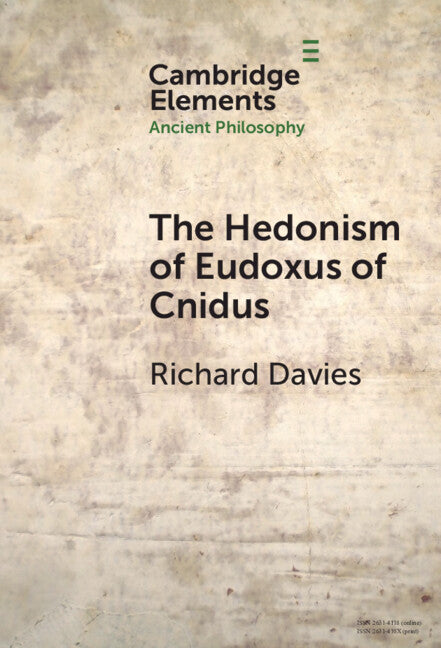
The Hedonism of Eudoxus of Cnidus
This Element discusses arguments for a pure version of the doctrine of hedonism: the theory that pleasure is the good.
Richard Davies (Author)
9781009462600, Cambridge University Press
Hardback, published 21 December 2023
74 pages
23.5 x 15.8 x 1 cm, 0.26 kg
Mathematician and astronomer Eudoxus of Cnidus was a younger contemporary of Plato and an older contemporary of Aristotle, on both of whom he exerted some influence during his stays in Athens. This is perhaps most apparent with regard to his ethical doctrine that identifies the good as pleasure (hedonism). While Plato seems rather unsure how seriously to take this proposal, Aristotle provides the materials for reconstructing the battery of ingenious arguments that Eudoxus brought forward in its defence. Taken together in this Element, these arguments foreshadow almost everything that has been said in the Western tradition in favour of the positive value of pleasure, and, if taken aright, point in the direction of a hedonism that sets store by the cultivation of activities akin to those for which Eudoxus has been most renowned: mathematics and astronomy.
1. Eudoxus: who he?
2. Two anonymous appearances in Plato
3. Witness
4. Addition
5. Honour
6. Opposites
7. Cradle
8. End
9. How much did Aristotle accept from Eudoxus?
References.
Subject Areas: Western philosophy: Ancient, to c 500 [HPCA]