Freshly Printed - allow 7 days lead
Couldn't load pickup availability
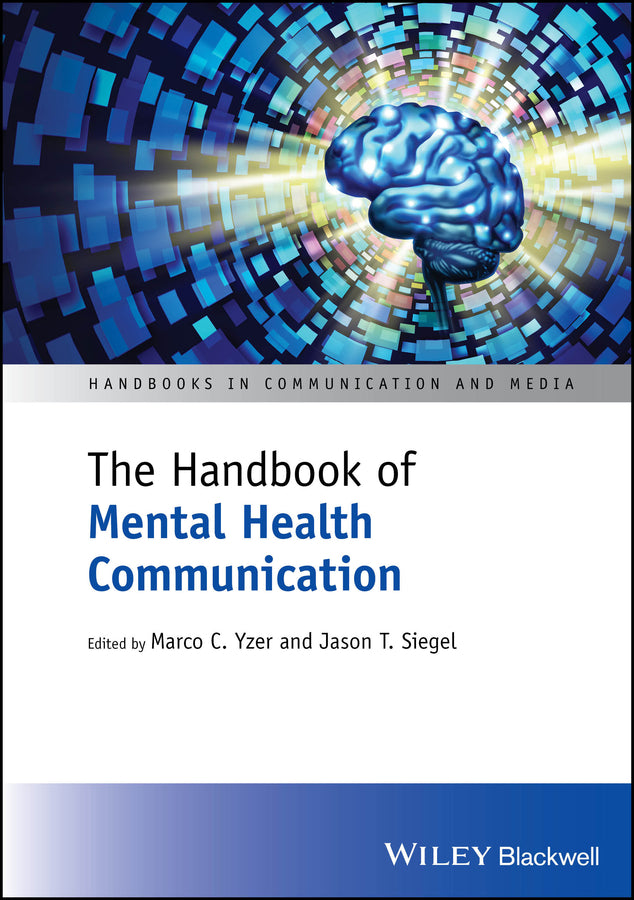
The Handbook of Mental Health Communication
Marco C. Yzer (Edited by), Jason T. Siegel (Edited by)
9781394179862, Wiley
Hardback, published 25 March 2025
528 pages
25.4 x 17.8 x 3.1 cm, 1.134 kg
"The Handbook of Mental Health Communication represents a milestone in health communication scholarship. Its interdisciplinary scope, methodological transparency, and ethical sensibility deliver a comprehensive synthesis that advances mental health communication as a distinct and mature domain of enquiry" - Utah Journal of Communication, 3(2)
The first book of its kind to offer a transdisciplinary exploration of mass communication approaches to mental health In the Handbook of Mental Health Communication, a panel of leading scholars from multiple disciplines presents a comprehensive overview of theory and research at the intersection of mass communication and mental health. With timely and authoritative coverage of the impact of message-based mental health promotion, this unique volume places mental health communication in the context of socio-cultural causes of mental illness — synthesizing public health, psychopathology, and mass communication scholarship into a single volume. Throughout the Handbook, nearly one hundred contributing authors emphasize that understanding communication effects on mental health outcomes begins with recognizing how people across the spectrum of mental illness process relevant information about their own mental health. Fully integrated chapters collectively translate biased information attention, interpretation, and memory in mental health illness to real-world implications of mental illness symptomatology and across the spectrum of mental health issues and disorders. Providing a clear, evidence-based picture of what mental health promotion should look like, The Handbook of Mental Health Communication is an invaluable resource for advanced undergraduate and graduate students, scholars, researchers, lecturers, and all health communication practitioners.
List of Contributors ix Preface xiii Introduction 1. Mental Health Mass Communication: Using Messages to Relieve the Plight of People With Mental Illness 3 Part I Mental Illness and Information Processing 2. Emotional Information-Processing Biases in Psychopathology 19 3. Neural Correlates of Psychopathology: Implications for the Processing of Persuasive Health Messages 33 4. Cognitive Deficits in Major Depression: Characteristics, Role, and Relevance 49 5. The Impact of Self-and Partner Schemas on Information Processing and Treatment Seeking in Depression 65 Part II Conceptualization and Measurement of Primary Variables 6. A Typology of Health Communication Variables Relevant for Mental Health 79 7. Introducing Health Communication Science to Mental Health Researchers: An Examination of Information Seeking, Processing, and Dissemination Frameworks 93 8. Pretesting and Selecting Messages Using Perceived Message Effectiveness Ratings 109 9. The Conceptualization, Measurement, and Reduction of Self-Stigma of Seeking Help 125 10. Advancing the Measurement of Mental Illness Stigma: Considerations of Time, Structural Stigma, and Intersectionality 141 11. Refining the Concept of Mental Health Literacy: Criteria for Determining What the Public Needs to Know 155 Part III Digital Media and Mental Health 12. Cracking the Code of Gaming Disorder: Effective Communication for Parents, Children, and Policymakers 167 13. Chatbots for Mental Health: A Network-Oriented Modeling Perspective 181 14. mHealth for Mental Health: Expanding the Reach of Care 193 15. Mental Health Apps and Privacy: Misunderstandings and Messaging 207 Part IV Special Populations, Mental Health Disparities, and Communication Inequalities 16. Considerations for Optimizing Mental Health Communication to Advance Mental Health Equity 225 17. Affinity and Advocacy: Online Communities for People Experiencing Mental Health Conditions 241 18. Well-Being Among Physicians in Training: Barriers to Treatment and Efforts to Increase Help Seeking for Depression 263 19. Communication, Equity, and Mental Well-Being: The Road Ahead 281 Part V Stigma Reduction 20. Stigmatizing Communication and Mental Health 297 21. Reducing Mental Health Stigma Through School-Based Interventions: Assessing the Evidence and Translating It into Practice 313 22. Application of Weiner’s Attribution-Emotion-Action Model to Increase Support to People With Depression 329 23. The Benefits and Unintended Consequences of Anti-Stigma Campaigns 347 Part VI Promising Strategies 24. Minimizing Reactance to Increase Help Seeking for Depression 363 25. Suicide Prevention Media Campaigns: An Application of the Papageno Effect 377 26. Positive Emotion Infusions as a Means of Increasing Help Seeking Among People Experiencing Depression: Savoring, Elevation, and Gratitude 385 27. A Research Protocol for Determining Depression Help-Seeking Message Content 399 28. Investigating Help-Seeking Attitudes Among People With Varying Levels of Depressive Symptomatology: An Attitude-Strength Diagnostic Approach 413 Part VII Lessons Learned 29. My Third Child: The Journal Health Communication and Some Lessons for Mental Health Communication 433 30. The Efficacy of Multi-Behavior Interventions: From Physical Health to Mental Health 445 31. Lessons from Digital Health Research 457 32. Persuasive Prevention Strategies in Health Communication 467 33. Maximizing Mental Health Communication: The IIFF Model of Help Seeking for Depression 479 Index 497
Marco C. Yzer and Jason T. Siegel
Lisa M. W. Vos, Tom Smeets, and Jonas Everaert
Caroline Ostrand and Monica Luciana
Elayne Ahern Copyrighted Material
Fei Ying, Gabriela C. M. Murphy, and David J. A. Dozois
Romy RW, Xingman Wu, Rudy Sunrin Kim, and Xiaoli Nan
Brian Quick, Sarah Caban, Minhey Chung, and Jia Yan
Seth M. Noar, Haijing Ma, and Jacob A. Rohde
David L. Vogel, Patrick J. Heath, Rachel E. Brenner, Daniel G. Lannin, and Nan Zhao
Annie B. Fox, Xueli Qiu, Mohammad Mousavi, and Valerie A. Earnshaw
Anthony F. Jorm
Kylie Woodman and René Weber
Gert-Jan de Bruijn, Fakhra Jabeen, and Tibor Bosse
Nancy Lau, Lola Kola, Xin Zhao, Seth Asafo, Dzifa Attah, and Dror Ben-Zeev
Jolynn Childers Dellinger
Crystal L. Barksdale, Collene Lawhorn, Jennifer Alvidrez, and Kat Schwartz
Frances J. Griffith and Sydney C. Simmons
Sabrina Menezes and Gregory Guldner
Laura Marciano, Ava Kikut-Stein, and K. Viswanath
Xun Zhu, Rachel A. Smith, and Ruth A. Osoro
Ashley Johnston, Supriya Misra, Rachel Banawa, John Anagnost, and Daniel Eisenberg
Tara Muschetto and Jason T. Siegel
Miranda Twiss, Nataliya Turchmanovych-Hienkel, and Patrick Corrigan
Christopher M. Falco and Benjamin D. Rosenberg
Thomas Niederkrotenthaler, Stefanie Kirchner, Benedikt Till, Angela Nicholas, Maria Ftanou, and Jane Pirkis
Tasha Straszewski and Jason T. Siegel
Marco C. Yzer and Xuan Zhu
Jason T. Siegel and Cara N. Tan
Teresa L. Thompson
Wenhao Dai and Dolores Albarracín
Jenna Reno, Kevin Wombacher, and Brian Southwell
William D. Crano
Jason T. Siegel and Marco C. Yzer
Subject Areas: Sociology & anthropology [JH]