Freshly Printed - allow 7 days lead
Couldn't load pickup availability
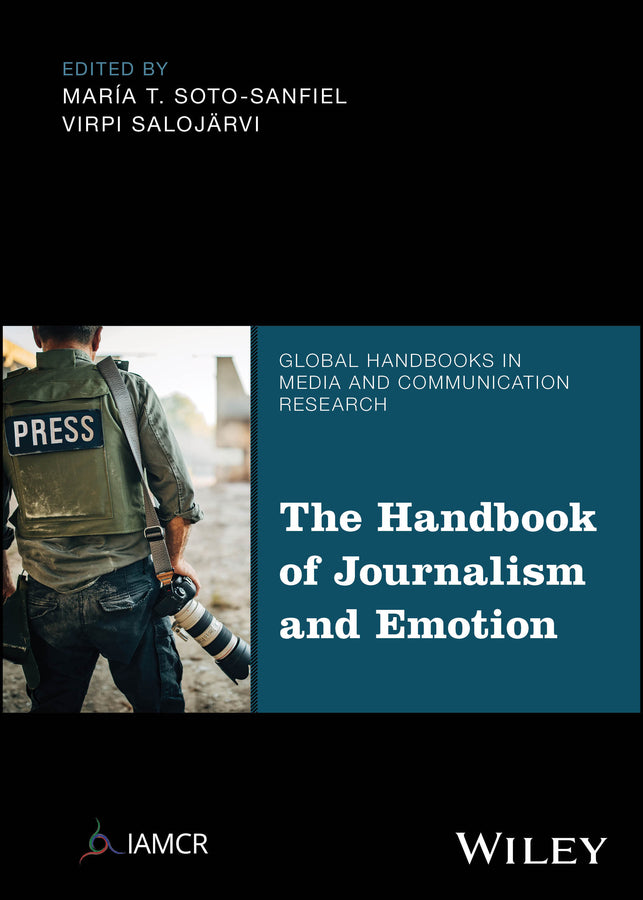
The Handbook of Journalism and Emotion
María T. Soto-Sanfiel (Edited by), Virpi Salojärvi (Edited by)
9781394169382, Wiley
Hardback, published 30 March 2026
528 pages
1 x 1 x 1 cm, 0.454 kg
A groundbreaking global exploration of how emotions shape journalism Emotion is no longer peripheral to journalism—it is central to how news is made, shared, and experienced. The Handbook of Journalism and Emotions: Theory, Production, Content and Responses redefines how we understand journalism in today’s emotionally charged world, bringing together 60 leading scholars from across five continents to investigate how emotion shapes journalism theory, production practices, content, and audience engagement. Organized into four thematic sections—Theory, Production, Content, and Responses—the Handbook covers topics ranging from emotional labor and trauma in reporting to audience reactions and emotional authority in visual storytelling. Drawing from sociology, psychology, communication, linguistics, and neuroscience, in-depth chapters highlight how emotional forces interact with journalistic values, ethics, and norms. Throughout the book, in-depth chapters respond to the growing scholarly and professional recognition of the “emotional turn” in media studies, filling a critical gap in media and communication scholarship. The first book to provide an interdisciplinary, multicultural, and methodologically diverse analysis of the pivotal role of emotion across all dimensions of journalism, the Handbook of Journalism and Emotions: Ideal for scholars, students, and professionals, the Handbook of Journalism and Emotions: Theory, Production, Content and Responses is a core reference for courses in journalism, communication, media and cultural studies, and emotion research. It is also a key resource for journalists, editors, media educators, and policymakers seeking to understand and teach the emotional complexities of modern journalism.
List of Contributors ix Foreword: The Normalization and Maturation of Research on Emotion in Journalism xiii Emotions: The Driving Force Behind Journalistic Practices 1 Section 1 Theory 5 1 Feeling as Knowing: Emotions and Epistemology in Journalism Studies 7 2 A Historical Approach on Emotion and Journalism: Systematic Literature Review 17 3 Toward an Affect- Inclusive Definition of Journalism: Reconceiving News to Present the Whole Human Experience 29 4 Emotional Labor in Journalism: A Systematic Review 41 5 Peace Journalism Approach to Emotional Responsibility in News Production 53 6 Evoking Emotion: A Call to Understand “Sensationalism” and Its Appeal From Audience Perspectives 63 7 The Rise of Emotionalized Anti- Press Discourse and Harassment of Journalists: A Global Perspective 73 8 Decolonizing Journalism in Ibero- America and the Caribbean: Embracing Emotional Dimensions and Well- Being in a Transformative and Critical Media Landscape 85 9 Rethinking Emotions and Ethics in Journalism: Toward a Feminist Ethics of Care 97 10 Reporting a World- in- Crisis: It’s Going to Be Emotional! 109 Section 2 Production Process 121 11 How Do Journalists Manage Emotions and Trauma: A Reflection on Theory and Practice 123 12 Journalists and Emotions in Covering Crisis, Conflict, and War 133 13 The Collective Dimension of Fear in Journalism Practice 143 14 Precarious Jobs, Stress, and Mental Health: A Portrayal of Journalism in Spain 157 15 Emotions and Perceptions of “Journalism in Crisis”: Exploring the Impact of Sociopolitical Experiences on Journalistic Feelings of Crisis in Hong Kong and Singapore 169 16 Emotions and the Challenges of a Post- Truth Era: A Comparison of British and Indian TV Newsrooms 181 17 The Emosphere: A Theoretical Approach to Human Emotional Communication in the Context of Journalism 193 18 “Where are You, My Love? I am Here My Love!”: The Role of Emotions in Practicing Citizen Journalism During Gezi Park Movement in Turkiye 205 19 Reconsidering and Moving On: Exploring Emotional Intensity and the Factors that Prompt Journalists to Leave the Field 217 20 Re- orienting Well- Being to Produce News: Emotional Labor and Strategies Among Women Journalists Experiencing Regular and Isolated Violence 231 Section 3 Content 243 21 The Role of Emotions in Journalism: A Linguistic and Multimodal Perspective 245 22 From Bold Headlines to Alluring Click Baits: The Pursuit of Emotionality in Western News Through a Historical Lens 255 23 The More We See, The More We Care? Emotional Authority and Political Ambiguity in Media Spectacle of Atrocity267 24 The [Muffled] Angry Woman Journalist 279 25 Emotions at the Intersection of Journalism and Activism: A Case Study of Colombian Female Journalists 291 26 Beyond the Angry Arab Stereotype: Emotions in the Articulation of News in the Arab Region 305 27 Humor at War as an Instrument of Resistance on Popular Ukrainian Telegram Channels 317 28 Emotion Over the Airwaves: Considering Nuances in Linguistic and Production Choices in African Radio News Through the Affective News Framework 329 29 AI News Anchors and the Problem of (Lack of) Emotional Engagement 343 30 Influence of Voice and Emphasis When Convening News 353 Section 4 Responses: Organizations, Journalists and Audiences 365 31 Emotions as Audience Responses and Effects: A Media Psychology Perspective 367 32 News Expectancy Violations and Emotions 379 33 How News Organizations React to Online Sexual Harassment Against Female Journalists in Hong Kong, Mainland China, and Taiwan 391 34 Negative Emotions in News Reception: An Approach to News Avoidance in the Global North Versus the Global South 403 35 Emotional Responses of Zimbabwean Journalists to Online Trolling 419 36 Journalism and Emotions in the African Context: Exploring the Emotional Effects of Reporting Trauma Among Kenyan Journalists 433 37 The Ethical Potential of Care and Emotion: Insights from Documentary Filmmaking 443 38 Information Disorders, Hateful Discourses, and Journalists: When the Messenger Becomes the Victim 453 39 Emotions in Immersive Journalism 463 40 Empathy Training: Empowering Journalists with a Neglected Method of Inquiry 473 Index 485
Karin Wahl- Jorgensen
Johana Kotišová and Richard Stupart
Rita Araújo
Perry Parks
Maja Šimunjak
Metin Ersoy, Ahmad Muhammad Auwal, and Tamar Haruna Dambo
Josephine Lehaff
Wooyeol Shin and Changwook Kim
Martín Oller Alonso
Lambrini Papadopoulou and Eugenia Siapera
Simon Cottle
Stephen Jukes
Kristin Skare Orgeret
Virpi Salojärvi and María T. Soto- Sanfiel
Dolors Palau- Sampio and Maria Iranzo- Cabrera
Shangyuan Wu
Antje Glück
Teija Waaramaa
Şahika Doğan
T. J. Thomson and Albertus Magnus Prestianta
Bruno Frutuoso Costa
Isabel Alonso- Belmonte
Magnus Danielson
Noora Kotilainen
Dinfin K. Mulupi and Linda Steiner
Marta Milena Barrios
Nassir Bouali and Jairo Lugo- Ocando
Nataliia Steblyna and Jaroslav Dvorak
Sisanda Nkoala, Christina Chan- Meetoo, and Modestus Fosu
Bibo Lin and Tingyu Zou
Emma Rodero
Juan- José Igartua
Robin Blom
Luqiu Luwei Rose
Javier Serrano- Puche and María Fernanda Novoa- Jaso
Mphathisi Ndlovu and Mbongeni J. Msimanga
Olatunji Ogunyemi and Benjamin Muindi
Erika T. Walukiewicz
David Blanco- Herrero and Javier J. Amores
Kamilla Bergsnev and Ana Luisa Sánchez Laws
Janet Blank- Libra
Subject Areas: Society & culture: general [JF]