Freshly Printed - allow 7 days lead
Couldn't load pickup availability
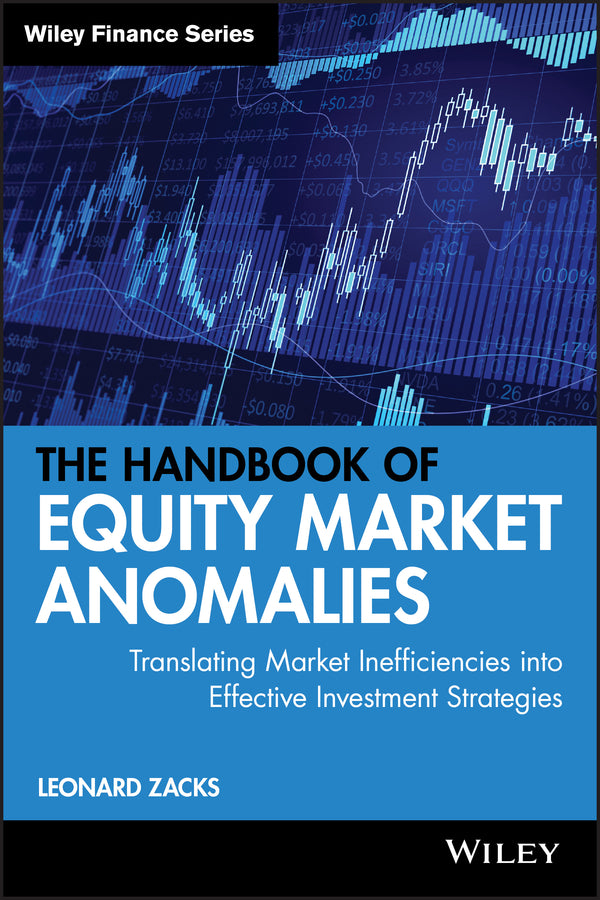
The Handbook of Equity Market Anomalies
Translating Market Inefficiencies into Effective Investment Strategies
Leonard Zacks (Edited by)
9780470905906, Wiley
Hardback, published 28 October 2011
352 pages
23.6 x 16.1 x 3.1 cm, 0.553 kg
Investment pioneer Len Zacks presents the latest academic research on how to beat the market using equity anomalies The Handbook of Equity Market Anomalies organizes and summarizes research carried out by hundreds of finance and accounting professors over the last twenty years to identify and measure equity market inefficiencies and provides self-directed individual investors with a framework for incorporating the results of this research into their own investment processes. Edited by Len Zacks, CEO of Zacks Investment Research, and written by leading professors who have performed groundbreaking research on specific anomalies, this book succinctly summarizes the most important anomalies that savvy investors have used for decades to beat the market. Some of the anomalies addressed include the accrual anomaly, net stock anomalies, fundamental anomalies, estimate revisions, changes in and levels of broker recommendations, earnings-per-share surprises, insider trading, price momentum and technical analysis, value and size anomalies, and several seasonal anomalies. This reliable resource also provides insights on how to best use the various anomalies in both market neutral and in long investor portfolios. A treasure trove of investment research and wisdom, the book will save you literally thousands of hours by distilling the essence of twenty years of academic research into eleven clear chapters and providing the framework and conviction to develop market-beating strategies. As the founder of Zacks Investment Research, Len Zacks pioneered the concept of the earnings-per-share surprise in 1982 and developed the Zacks Rank, one of the first anomaly-based stock selection tools. Today, his firm manages U.S. equities for individual and institutional investors and provides investment software and investment data to all types of investors. Now, with his new book, he shows you what it takes to build a quant process to outperform an index based on academically documented market inefficiencies and anomalies.
Preface xi Acknowledgments xvii CHAPTER 1 Conceptual Foundations of Capital Market Anomalies 1 Efficient Markets 2 Identifying Anomalies in Capital Markets 3 Explaining Anomalies 5 Anomalies: Weighing the Evidence 10 Appendix 1.1: Risk and Expected-Return Models 10 References 17 CHAPTER 2 The Accrual Anomaly 23 What Are Accruals? 24 Sloan (1996) in a Nutshell 32 Extensions of Sloan (1996) 38 Alternative Explanations for the Accrual Anomaly 45 Practical Implications 51 Appendix 2.1: Estimation and Testing Framework Used in Sloan (1996) 52 Appendix 2.2: Details on the Broader Definition of Accruals 54 References 59 CHAPTER 3 The Analyst Recommendation and Earnings Forecast Anomaly 63 Role of Research Analysts 63 Investment Recommendations 64 Earnings Forecast Revisions 73 Determinants of Forecast Revisions 76 International Evidence 78 Overview of the Investment Performance of Forecast Revisions 79 Appendix 3.1: Details of Returns to Recommendation Strategies 79 References 87 CHAPTER 4 Post-Earnings Announcement Drift and Related Anomalies 91 The Basics of the Anomaly 92 Measuring Earnings Surprises 99 Sources of Post-Earnings Announcement Drift 102 Extensions 106 Institutional Investors 108 Individual Investors 110 References 112 CHAPTER 5 Fundamental Data Anomalies 117 Fundamental Metrics 118 Distress Risk 122 Capital Investment and Growth Anomalies 123 International Evidence 125 Conclusion 126 References 126 CHAPTER 6 Net Stock Anomalies 129 Initial Public Offerings 130 Seasoned Equity Offerings 132 Debt Issuances 133 Share Repurchases and Tender Offers 134 Dividend Initiation and Omissions 136 Private Equity Placement 138 Overall Net External Financing 138 Mergers and Acquisitions 141 International Evidence 142 Other Explanations for the Abnormal Returns 143 References 144 CHAPTER 7 The Insider Trading Anomaly 147 Overview of Insider Filings 148 Documentation of the Anomaly 148 Results for the 1978–2005 Period 150 How Consistent Is the Anomaly Year by Year? 152 When Are Returns Generated during the 1-Year Holding Periods? 154 Returns in Small Cap versus Large Cap 155 Does It Work on the Short Side? 156 Do Returns Vary by Industry? 160 Institutional Investors 162 Individual Investors 162 Relation to Other Anomalies 163 International Evidence 164 Can Insider Data Predict S&P 500 Returns? 165 Latest Developments 166 Long/Short Strategy for Institutional Investors 167 References 170 CHAPTER 8 Momentum: The Technical Analysis Anomaly 173 History of Technical Analysis and Momentum 176 Assessing Momentum and Reversal in Stock Prices 178 Early Influential Work on Momentum and Reversals 179 Improving Upon Momentum Strategies 184 Moving Averages 186 52-Week High/Low 187 Momentum at Industry Levels 188 Momentum and Mutual Funds 189 Is Technical Analysis Profitable? 190 Institutional Investors 193 Explanations for Momentum and Reversals 195 International Evidence 198 References 200 CHAPTER 9 Seasonal Anomalies 205 January Effect 206 The January Barometer 213 Sell-in-May-and-Go-Away 221 Holiday Effects 226 Day-of-the-Week Effects 231 Seasonality Calendars 234 Political Effects 237 Turn-of-the-Month Effects 248 Open/Close Daily Trade on the Open 254 Weather: Sun, Rain, Snow, Moon, and the Stars 255 Conclusions and Final Remarks 256 References 256 CHAPTER 10 Size and Value Anomalies 265 The Early Days 265 Fama-French Three-Factor Model 266 Value Anomaly: Risk or Mispricing? 267 Alternative Value Indicators 269 Time Variation in the Value Premium 270 Cross-Sectional Variation in the Value Premium 273 Anatomy of the Size Anomaly 275 International Evidence 278 Value Premium: Evidence from Alternative Asset Classes 279 References 281 CHAPTER 11 Anomaly-Based Processes for the Individual Investor 285 Increasing Returns Using Market Neutral 286 Using ETFs to Add a Market Neutral Asset to a Portfolio 291 Using Stock Scoring Systems to Outperform Indexes 292 Implementation of Anomaly-Based Quant Processes 296 End of the Tour 305 References 305 APPENDIX Use of Anomaly Research by Professional Investors 307 From Academia to Wall Street 307 Statistical Arbitrage 308 High-Frequency Trading 309 Multifactor Models 309 Assets in Market Neutral Portfolios 310 Assets in Long Portfolios 311 United States versus International 313 References 314 About the Contributors 317 Index 323
Mozaffar Khan
Patricia M. Dechow, Natalya V. Khimich, and Richard G. Sloan
George Serafeim
Daniel Taylor
Ian Gow
Daniel Cohen, Thomas Lys, and Tzachi Zach
Ian Dogan
Lee M. Dunham
Constantine Dzhabarov and William T. Ziemba
Oleg A. Rytchkov
Leonard Zacks
Subject Areas: Finance & accounting [KF]