Freshly Printed - allow 7 days lead
Couldn't load pickup availability
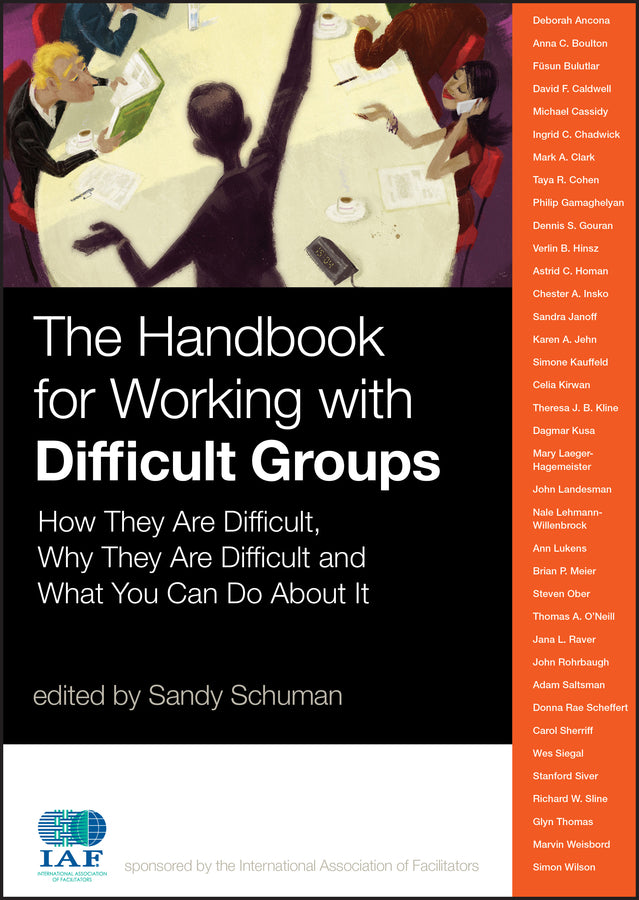
The Handbook for Working with Difficult Groups
How They Are Difficult, Why They Are Difficult and What You Can Do About It
Sandy Schuman (Author)
9780470190388, Wiley
Hardback, published 18 May 2010
480 pages, Tables: 20 B&W, 0 Color; Exhibits: 30 B&W, 0 Color
24.4 x 18.8 x 3.8 cm, 0.839 kg
WE'VE ALL EXPERIENCED the challenges associated with working with groups, but The Handbook for Working with Difficult Groups turns the idea of "difficult groups" on its head. Rather than view groups as inherently difficult, it looks at the factors that make working with groups difficult. Individual chapters focus on challenges such as involving dissenters, building external perspectives, reducing complaining, adapting to cultural differences, incorporating diversity, facilitating inclusion, working virtually, resolving identity-based conflict, transforming unproductive behavior patterns, preventing workplace harassment, and strengthening accountability. The book first provides a framework for thinking systemically about the many and varied ways in which working with a group can be difficult. Building on that framework, the contributors each address three basic issues:
Preface xi About the Contributors xv Introduction Make sense out of what makes working with groups difficult. One Keeping Difficult Situations from Becoming Difficult Groups 1 Dissenters need support, or the group risks going off track. Two Building an External Focus: Avoiding the Difficulties on an In-grown Team 17 The critical importance of an external perspective. Three The Downside of Communication: Complaining Cycles in Group Discussions 33 Help teams get out of the ‘‘complaining loop’’ and turn to solution-oriented interaction instead. Four Facilitating Multicultural Groups 55 Customize structures and processes to match groups’ cultural preferences. Five Interpersonally Hostile Work Groups: Precipitating Factors and Solutions 77 A group perspective on workplace harassment and bullying is essential to understanding and preventing it. Six Diversity by Design: Creating Cognitive Conflict to Enhance Group Performance 95 Ill defined, diversity might undermine a group’s purpose. Seven Facilitating Inclusion: Study Circles on Diversity and Student Achievement 113 Bridging differences in culture and ethnicity can foster academic achievement Eight Overcoming Sources of Irrationality That Complicate Working in Decision-Making Groups 137 Six factors make working with this group difficult in many different ways. Nine Working Without Rules: A Team in Need of a Different Picture 153 Affirmative language encourages new views of a team’s past and future. Ten Interaction Archetypes: Keys to Group Difficulty and Productivity 169 Identify the repetitive behavioral sequences that reduce a group’s ability to produce results. Eleven Virtual Teams: Difficult in All Dimensions 189 Group members working virtually and interdependently face enormous challenges. Twelve Politics of the Arts: Challenges in Working with Nonprofit Boards 207 A ‘‘confessional tale’’—lessons learned while facilitating an arts board in transition. Thirteen Competitive Group Interactions: Why They Exist and How to Overcome Them 223 Groups are less cooperative than individuals—learn how you can reduce intergroup conflict. Fourteen Active Facilitation: How to Help Groups Break Through ‘‘Mutual Stalemate’’ 237 Groups may abdicate their responsibilities waiting until another group makes the first move. Fifteen Mediating History, Making Peace: Dealing with the ‘‘Messy’’ Stuff in the Conciliation Process 251 Identity-based conflicts will not achieve long-term solutions through resource-based settlements. Sixteen Deep Democracy: Multidimensional Process-Oriented Leadership 275 Learn to track the shifting roles of group members. Seventeen Authentic Relationships and Collective Psychological Capital 293 How leader behavior can undermine group success. Eighteen How Leaders Can Make Diverse Groups Less Difficult: The Role of Attitudes and Perceptions of Diversity 311 Perceptions that lead to subgrouping can override the positive effects of diversity. Nineteen The Hero’s Journey: Helping Inflexible Groups—and Inflexible Facilitators—Get Unstuck 323 Use the Hero’s Journey as an analytical and facilitation tool to help groups and facilitators get out of difficulties. Twenty Difficult Groups or Difficult Facilitators? Three Steps Facilitators Can Take to Make Sure They Are Not the Problem 339 Facilitators can unknowingly contribute to the difficulties their group’s experience. Key Terms 353 References 367 Name Index 401 Subject Index 409
Sandor Schuman
Working with Difficult Groups: A Conceptual Framework xxix
Sandor Schuman and John Rohrbaugh
Marvin Weisbord and Sandra Janoff
Deborah Ancona and David F. Caldwell
Nale Lehmann-Willenbrock and Simone Kauffeld
Donna Rae Scheffert and Mary Laeger-Hagemeister
Jana L. Raver and Ingrid C. Chadwick
Michael Cassidy
Mark A. Clark and John Landesman
Dennis S. Gouran
Ann Lukens
Steven Ober
Thomas A. O’Neill and Theresa J. B. Kline
Richard W. Sline and Anna C. Boulton
Taya R. Cohen, Brian P. Meier, Verlin B. Hinsz, and Chester A. Insko
Celia Kirwan and Wes Siegal
Dagmar Kusa, Adam Saltsman, and Philip Gamaghelyan
Stanford Siver
Füsun Bulutlar
Astrid C. Homan and Karen A. Jehn
Carol Sherriff and Simon Wilson
Glyn Thomas
Subject Areas: Business & management [KJ]