Freshly Printed - allow 10 days lead
Couldn't load pickup availability
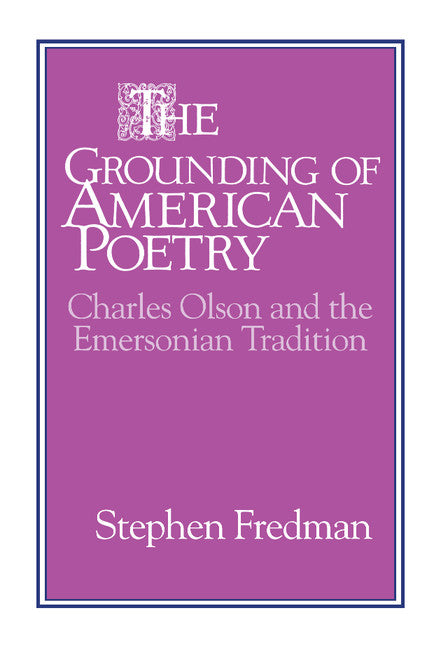
The Grounding of American Poetry
Charles Olson and the Emersonian Tradition
Stephen Fredman asserts in his work that American poetry is groundless.
Stephen Fredman (Author)
9780521443036, Cambridge University Press
Hardback, published 28 May 1993
186 pages
23.7 x 16 x 1.3 cm, 0.399 kg
"Cogent, persuasive and at times dazzling, this book makes an impressive and innovative contribution to understanding the influence of Emerson and the transcendentalists on the Black Mountain poets in particular, but also American poetic practice in general." Tim Woods, English
Stephen Fredman asserts in his work that American poetry is groundless - that each generation of American poets faces the problem of identity anew and has to discover fresh meaning for itself. His argument focuses on four pairs of poets - Eliot/Williams, Thoreau/Olson, Emerson/Duncan and Whitman/Creeley - and points out that although the later ones all were influenced by their predecessors to some extent, ultimately their poetry is, paradoxically, grounded in an essential groundlessness. In order to demonstrate how approaches to groundlessness have persisted over time, Fredman explores the various measures taken by these American poets to provide a provisional ground upon which to construct their poetry: inventing idiosyncratic traditions, forming poetic communities, engaging in polemical prose, assessing all the dimensions of particular places and treating words as emblematic and mysterious objects. At the very core of the book stands Charles Olson, whose work so dramatically articulates the whole range of issues arising from the American poet's anxious search for and resistance t, an authentic and unified tradition.
Introduction
1. Williams, Eliot and American tradition
2. Finding out for oneself
3. Resistance and poetic community
4. The poetics of recognition
5. Circles and boundaries
6. Conclusion
Notes
Index.
Subject Areas: Literary studies: poetry & poets [DSC]