Freshly Printed - allow 7 days lead
Couldn't load pickup availability
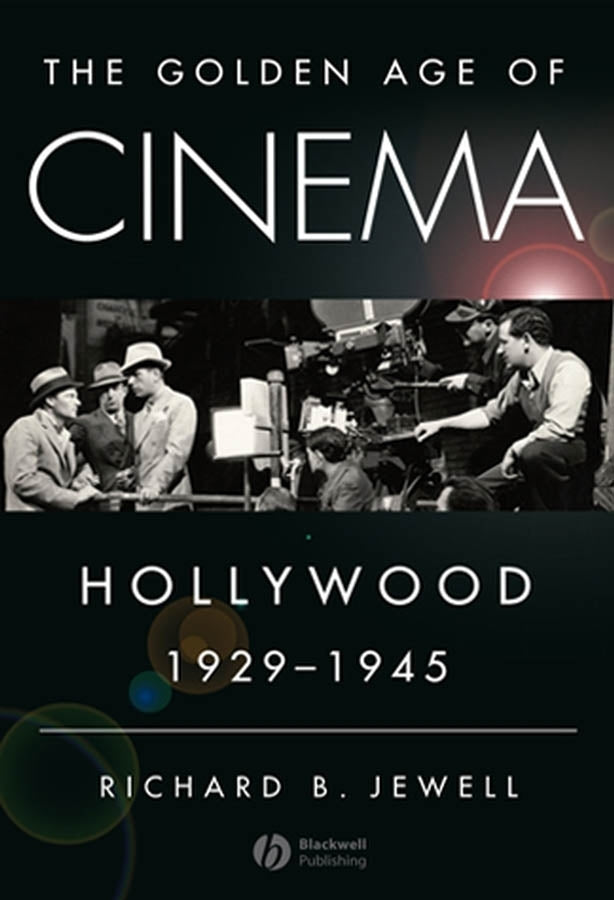
The Golden Age of Cinema
Hollywood, 1929-1945
Richard Jewell (Author)
9781405163729, Wiley
Hardback, published 9 August 2007
368 pages
23.6 x 15.8 x 2.5 cm, 0.644 kg
"Rick Jewell has been teaching a course on classical Hollywood moviemaking at USC for some years but has never found a textbook that suited his needs. As a result he has written one, and it’s excellent. Jewell has taken on the daunting task of surveying the social history of the period, the business side of Hollywood , changes and advancement in technology, censorship, narrative and style, genres, and the star system. Whew! I can’t imagine a better introduction to this subject matter. The book is scrupulously well organized and uses specific examples whenever possible instead of dealing in generalities." Leonard Maltin's Movie Crazy (www.leonardmaltin.com) “Some believe that American film peaked between the Stock Market Crash and the end of World War II. Richard B. Jewell’s The Golden Age of Cinema sharply delineates how the film industry worked during the period, casting light on the movies as business, technology, social document, and popular art.”
Charles J. Maland, University of Tennessee
This comprehensive book illuminates the most fertile and exciting period in American film, a time when the studio system was at its peak and movies played a critical role in elevating the spirits of the public. Richard B. Jewell offers a highly readable yet deeply informed account of the economics, technology, censorship, style, genres, stars and history of Hollywood during its "classical" era.
Title Page. Table of Contents. Figures and Captions. Acknowledgements. Dedication. Introduction. 1. Major Historical Events. 1.1. Economic Situation. 1.2. Societal Issues. 1.3. Hollywood Responds to the Crises. 1.4. Other Leisure Activities. 2. Film Business. 2.1. The Studios. 2.2. Production. 2.3. Distribution. 2.4. Exhibition. 3. Technology. 3.1. The Sound Revolution. 3.2. Color Film Production. 3.3. Wide-Screen Experiments of 1929-1931. 3.4. Special Effects. 4. Censorship. 4.1. Silent Era Background. 4.2. The Production Code. 4.3. “Pre-Code” Hollywood. 4.4. The Production Code Administration. 4.5. “Exploitation” Films and Foreign Imports. 4.6. Politics and the PCA. 4.7. The Outlaw. 4.8. The Office of War Information Bureau of Motion Pictures. 4.9. The PCA During the War. 5. Narrative and Style. 5.1. Narrative Strategies. 5.2. Stylistic Techniques. 5.3. Narrative in Stagecoach. 5.4. Style in Stagecoach. 5.5. A Note on “Studio” Style. 5.6. A Note on Genre Style. 5.7. A Note on Film Noir. 5.8. A Note on Directorial Style. 6. Genres. 6.1. The Western. 6.2. The Gangster Film. 6.3. The Adventure Film. 6.4. The Horror Film. 6.5. The Detective Film. 6.6. The War Film. 6.7. Comedy. 6.8. The Musical. 6.9. The Woman’s Film. 6.10. Other Genres. 7. Stars and the Star System. 7.1. The Star as Business Commodity. 7.2. The Multiplicity of Stars. 7.3. The Star as Actor. 7.4. The Most Popular Stars. 8. Conclusion. Index
Subject Areas: Society & culture: general [JF]