Freshly Printed - allow 10 days lead
Couldn't load pickup availability
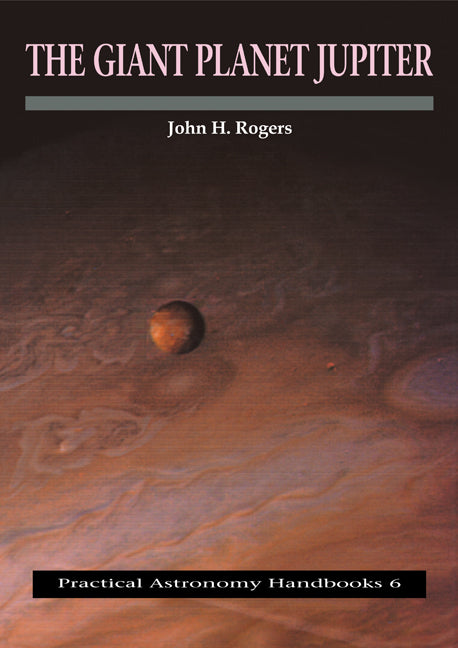
The Giant Planet Jupiter
This highly illustrated volume provides a comprehensive and accessible account of Jupiter and its satellites.
John H. Rogers (Author)
9780521115308, Cambridge University Press
Paperback / softback, published 2 July 2009
460 pages, 295 b/w illus. 50 colour illus. 80 tables
22.9 x 15.2 x 2.4 cm, 0.67 kg
Jupiter is an extraordinarily colourful and dynamic planet. Over minutes, one can watch tiny shadows cast by its moons slide over its surface; over days and weeks parades of diverse, giant swirling storms can be seen to move and evolve. It is because of this richness of visual and physical properties that Jupiter has intrigued amateur and professional astronomers and has been the goal of several space missions. This highly illustrated volume provides a comprehensive and accessible account of Jupiter and its satellites. It reviews systematic telescopic observations that have stretched over more than a hundred years, in addition to modern observations and theories, and the wealth of data from the Pioneer, Voyager and Ulysses space missions. As well as a thorough survey of the planet's atmosphere, this volume presents an up-to-date account of our present knowledge of Jupiter's satellites and magnetosphere, at a level accessible to the non-specialist. This volume provides the definitive account of Jupiter for advanced amateur astronomers, professional astronomers and planetary scientists.
Part I. Observing Jupiter: 1. Observations from Earth
2. Observations from spacecraft
Part II. The Visible Structure of the Atmosphere: 3. Horizontal structure: belts, currents, spots and storms
4. Vertical structure: colours and clouds
Part III. The Observational Record of the Atmosphere: 5. The Polar Region
6. North North Temperate Regions (57°N to 35°N)
7. North Temperate Region (35°N to 23°N)
8. North Tropical Region (23°N to 9°N)
9. Equatorial Region (9°N to 9°S)
10. South Tropical Region (9°S to 27°S)
11. South Temperate Region (27°S to 37°S)
12. South South Temperate Region (37°S to 53°S)
Part IV: The Physics and Chemistry of the Atmosphere: 13. Possible large-scale and long-term patterns
14. The dynamics of individual spots
15. Theoretical models of the atmosphere
16. The composition of the planet
Part V. The Electrodynamic Environment of Jupiter: 17. Lights in the Jovian night
18. The magnetosphere and radiation belts
Part VI. The Satellites: 19. The inner satellites and the ring
20. The Galilean satellites
21. Io
22. Europa
23. Ganymede
24. Callisto
25. The outer satellites
Appendices: 1. Measurement of longitude
2. Measurement of latitude
3. Lists of apparitions and published reports
4. Bibliography (The planet)
5. Bibliography (The magnetosphere and satellites)
Index.
Subject Areas: Popular astronomy & space [WNX]