Freshly Printed - allow 10 days lead
Couldn't load pickup availability
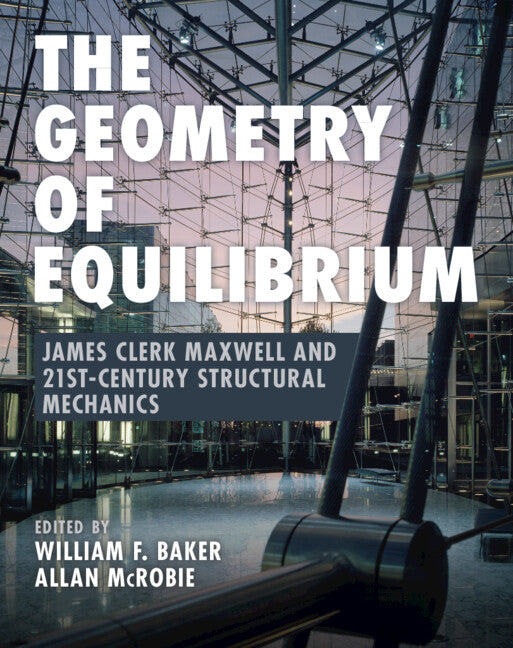
The Geometry of Equilibrium
James Clerk Maxwell and 21st-Century Structural Mechanics
The first book to examine James Clerk Maxwell's key discoveries in structural mechanics and their importance in the 21st century.
William F. Baker (Edited by), Allan McRobie (Edited by)
9781009397612, Cambridge University Press
Hardback, published 22 May 2025
324 pages
26.1 x 21 x 2.2 cm, 0.89 kg
'This rediscovery of James Clerk Maxwell by renowned expert opens a world of graphic statics, shell design and lightweight building for structural engineers. Maxwell's achievements turn out to be very modern because they help minimise the use of resources and, therefore, can lead to truly sustainable structures. What makes this book special is that the original papers of Maxwell are included and made readable through detailed explanations. A great effort by the authors for the benefit of the reader.' Mike Schlaich, Technische Universität Berlin
James Clerk Maxwell is one of the giants of scientific thought, and whilst his groundbreaking contributions to electromagnetism and statistical physics are well known, his profound insights into the theory of structures are appreciated less widely. Maxwell's approach was deeply geometrical, and this richly illustrated book reveals his astute perception of the remarkable dualities that exist between the form of a structure and the forces it can carry, with understandings that will surprise contemporary readers. Early chapters introduce the background in which Maxwell was working, followed by contributions by leading researchers describing the latest applications of these ideas. Subsequent chapters introduce the many subtopics that this work embraces. The book ends with Maxwell's original papers on structural mechanics, each annotated to highlight and explain the ideas therein. This is a wonderful resource for mathematicians, scientists, engineers, and designers to enter this rich and underexplored aspect of the genius of Maxwell.
List of Contributors
Preface
Editorial note
Part I. Maxwell and Structural Mechanics: 1. James Clerk Maxwell and structural mechanics William Baker and John Ochsendorf
2. The importance of Maxwell's writings for 21st-century structural mechanics William Baker, Petia Tzokova, Juney Lee and Allan McRobie
3. Geometric rigidity theory Robert Connelly, Simon Guest, Bernd Schulze and Walter Whiteley
4. Maxwell's relevance to modern research in materials Heinrich Jaeger, Sidney Nagel and Vincenzo Vitelli
5. Isotropic and architectural geometry Cameron Millar and Helmut Pottmann
6. A brief introduction to mid-19th-century projective geometry and topology Marina Konstantatou and William Baker
Part II. Concepts from Maxwell's Articles on Structural Mechanics: 7. Plane reciprocal diagrams Corentin Fivet, Allan McRobie and William Baker
8. Rules on counting, mechanisms and states of self-stress Allan McRobie and Marina Konstantatou
9. The unit load method and the Maxwell reciprocal theorem Petia Tzokova, William Baker and Allan McRobie
10. Maxwell's load path theorem William Baker and Petia Tzokova
11. Projections of polyhedra Marina Konstantatou, William Baker and Allan McRobie
12. Legendre transforms and polarities Allan McRobie and Marina Konstantatou
13. Rankine reciprocal diagrams in three dimensions Masoud Akbarzadeh, Tom Van Mele, Juney Lee, Marton Hablicsek and Philippe Block
14. Vector-based form and force diagrams in three dimensions Pierluigi D'Acunto and Patrick Ole Ohlbrock
15. The two methods of representing stress in a three-dimensional body Toby Mitchell
16. On the equilibrium of stress in a solid body Alessandro Beghini and Toby Mitchell
Part III. Annotated Original Articles by Maxwell on Structural Mechanics: note about this re-edition of Maxwell's papers
1864a. On reciprocal figures and diagrams of forces
1864b. On the calculation of the equilibrium and stiffness of
1867. On the application of the theory of reciprocal polar figures to the construction of diagrams of forces
1868. On reciprocal diagrams in space, and their relation to Airy's function of stress
1870a. On reciprocal figures, frames, and diagrams of forces
1870b. Communication: On reciprocal figures, frames, and diagrams of forces
1876. On Bow's method of drawing diagrams in graphical statics, with illustrations from Peaucellier's linkage
References
Index.
Subject Areas: History of mathematics [PBX]