Freshly Printed - allow 10 days lead
Couldn't load pickup availability
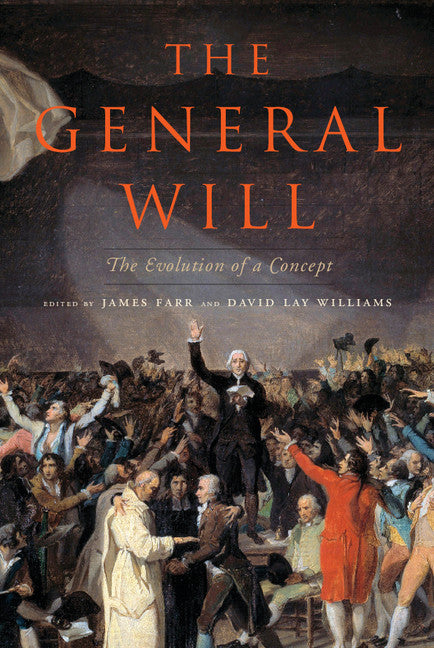
The General Will
The Evolution of a Concept
Includes essays by prominent political theorists and philosophers that trace the evolution of the general will from the seventeenth to the twentieth century.
James Farr (Edited by), David Lay Williams (Edited by)
9781107057012, Cambridge University Press
Hardback, published 16 February 2015
535 pages
23.5 x 15.8 x 2.8 cm, 0.86 kg
'Farr and Williams have given us the definitive volume on the history of the concept of the general will. Building on Patrick Riley's groundbreaking work, this distinguished group of scholars traces the concept from its earliest use in theological debate, through the early modern period, to its classic expression in the work of Rousseau, and then beyond Rousseau to modern contractarians. The General Will is essential reading for political theorists, philosophers and historians of ideas.' Elisabeth Ellis, University of Otago
Although it originated in theological debates, the general will ultimately became one of the most celebrated and denigrated concepts emerging from early modern political thought. Jean-Jacques Rousseau made it the central element of his political theory, and it took on a life of its own during the French Revolution, before being subjected to generations of embrace or opprobrium. James Farr and David Lay Williams have collected for the first time a set of essays that track the evolving history of the general will from its origins to recent times. The General Will: The Evolution of a Concept discusses the general will's theological, political, formal, and substantive dimensions with a careful eye toward the concept's virtues and limitations as understood by its expositors and critics, among them Arnauld, Pascal, Malebranche, Leibniz, Locke, Spinoza, Montesquieu, Kant, Constant, Tocqueville, Adam Smith and John Rawls.
Part I. The General Will before Rousseau: 1. The general will before Rousseau: the contributions of Arnauld, Pascal, Malebranche, Bayle, and Bossuet Patrick Riley
2. Malebranche's shadow: divine providence and general will in the Leibniz-Arnauld correspondence Steven Nadler
3. Locke's ideas, Rousseau's principles, and the general will James Farr
4. Spinoza and the general will David Lay Williams
5. Freedom, sovereignty, and the general will in Montesquieu Sharon R. Krause
Part II. The Prehistory of the General Will: 6. Rethinking Rousseau's tyranny of orators: Cicero's On Duties and the beauty of true glory Daniel J. Kapust
7. An American general will?: 'The bond of brotherly affection' in New England Andrew R. Murphy
Part III. The General Will in Rousseau: 8. The substantive elements of Rousseau's general will David Lay Williams
9. Justice, beneficence, and boundaries: Rousseau and the paradox of generality Richard Boyd
10. On the general will of humanity: global connections in Rousseau's political thought Sankar Muthu
11. The general will in Rousseau and after Rousseau Tracy B. Strong
Part IV. The General Will after Rousseau: 12. Kant on the general will Patrick Riley
13. The general will after Rousseau: Smith and Rousseau on sociability and inequality Shannon Stimson
14. Benjamin Constant's liberalism and the political theology of the general will Bryan Garsten
15. The general will after Rousseau: the case of Tocqueville Michael Locke McLendon
16. Rawls on Rousseau and the general will Christopher Brooke.
Subject Areas: Political ideologies [JPF], Political science & theory [JPA], Politics & government [JP], Social & political philosophy [HPS]