Freshly Printed - allow 10 days lead
Couldn't load pickup availability
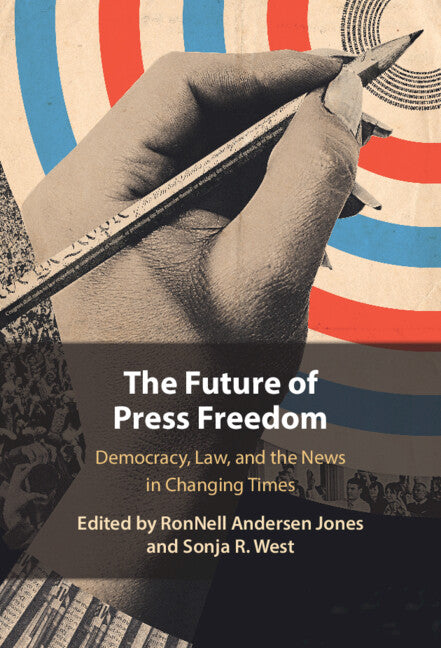
The Future of Press Freedom
Democracy, Law, and the News in Changing Times
This volume explores how law and policy can protect press freedom in a changing news landscape.
RonNell Andersen Jones (Edited by), Sonja R. West (Edited by)
9781009515535, Cambridge University Press
Hardback, published 24 July 2025
504 pages
22.9 x 15.2 x 2.7 cm, 0.5 kg
This groundbreaking volume assembles an unparalleled roster of media experts and First Amendment luminaries to chart the future of press freedom in America's changing media landscape. Current and former deans of top US law schools, a Pulitzer Prize-winning journalist, former Supreme Court clerks, and renowned scholars of law and communications offer their collective wisdom on safeguarding journalism amidst unprecedented challenges. Their contributions provide an incisive analysis of emerging threats to press freedom, from technological and economic disruptions to eroding public trust, while proposing innovative legal and policy solutions. The volume tackles cutting-edge issues like artificial intelligence in news production and the evolving definition of 'the press' in the digital age. Blending rigorous scholarship with practical insights, this essential resource equips journalists, press advocates, policymakers, and engaged citizens with expert knowledge to defend press freedom. This title is also available as Open Access on Cambridge Core.
Introduction
1. The future of press freedom RonNell Andersen Jones and Sonja R. West
Part I. Democracy and the Press Function: 2. The press and American democracy Robert Post
3. Political tensions and the democratic press Gregory P. Magarian
4. Post-newspaper democracy and the rise of communicative citizenship Nikki Usher
5. 'Murder the media': press freedom, violence, and the public sphere Joseph Blocher
Part II. Evolving Threats to the Press Function: 6. Fitting a square peg into a round hole: why traditional free press doctrines fail in dealing with newer media Erwin Chemerinsky
7. Countering the mosaic of threats to press functions Lili Levi
8. Defamation law and the crumbling legitimacy of the fourth estate Lyrissa Lidsky
9. Press benefits and the public imagination Erin Carroll
10. Recursive press freedom as the capacity to control and learn from mistakes Mike Ananny
Part III. Legal Protection for the Press Function: 11. Reinvigorating the press clause through negative theory Helen Norton
12. The constitutional exceptionalism of religion and the press Amanda Shanor
13. The other press clauses Christina Koningisor
14. The long shadow of food lion Alan K. Chen
15. The enduring significance of New York times v. Sullivan Samantha Barbas
16. Returning FOIA to the press Margaret B. Kwoka
Part IV. Identifying Performers of the Press Function: 17. From bloggers in Pajamas to the gateway pundit: how Government entities do and should identify professional journalists for access and protection Richard L. Hasen
18. A professional wrestler, privacy, and the meaning of news Amy Gajda
19. Reconstructing the first amendment: teaching disenfranchised perspectives on press freedom Meredith D. Clark
20. Journalism and academia: knowledge institutions buttressing constitutional democracy Vicki Jackson
21. Policing press freedom Hannah Bloch-Wehba
Part V. Supporting the Press Function: 22. The right to know Wesley Lowery
23. Distorting the press Heidi Kitrosser
24. Legal foundations for non-reformist media reforms: a positive-rights paradigm for guaranteeing a universal press system Victor Pickard
25. Innovation policy and the press Christina Koningisor and Jacob Noti-Victor
26. Are we saving the news? Martha Minow.
Subject Areas: Constitutional & administrative law [LND]