Freshly Printed - allow 10 days lead
Couldn't load pickup availability
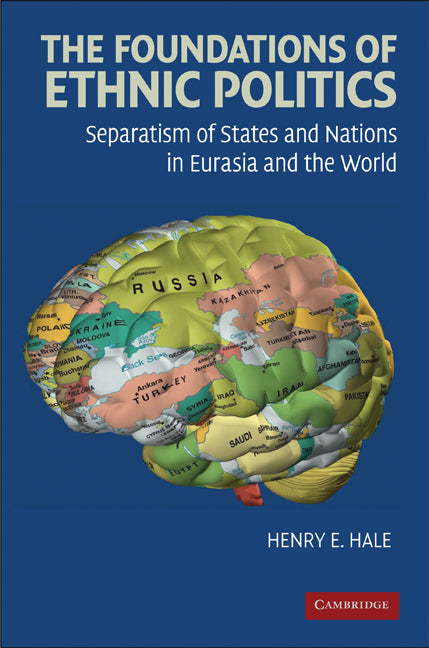
The Foundations of Ethnic Politics
Separatism of States and Nations in Eurasia and the World
Hale examines separatism in the USSR and CIS through a new psychological understanding of ethnic identity.
Henry E. Hale (Author)
9780521719209, Cambridge University Press
Paperback / softback, published 30 June 2008
298 pages, 6 b/w illus. 7 tables
23.4 x 15.6 x 1.7 cm, 0.46 kg
'Henry Hale … breaks fresh ground in The Foundations of Ethnic Politics, positing a relational theory of ethnicity at the centre of which is an acknowledgement that 'uncertainty reduction is a fundamental human motivation driving the near-universal tendency for humans to divide themselves into groups' (p. 35). … This is an important book that will shape all future writing on the subject.' Political Studies Review
Despite implicating ethnicity in everything from civil war to economic failure, researchers seldom consult psychological research when addressing the most basic question: What is ethnicity? The result is a radical scholarly divide generating contradictory recommendations for solving ethnic conflict. Research into how the human brain actually works demands a revision of existing schools of thought. Hale argues ethnic identity is a cognitive uncertainty-reduction device with special capacity to exacerbate, but not cause, collective action problems. This produces a new general theory of ethnic conflict that can improve both understanding and practice. A deep study of separatism in the USSR and CIS demonstrates the theory's potential, mobilizing evidence from elite interviews, three local languages, and mass surveys. The outcome significantly reinterprets nationalism's role in CIS relations and the USSR's breakup, which turns out to have been a far more contingent event than commonly recognized.
Acknowledgements
Note on transliteration
1. Introduction
Part I. Theory with Worldwide Examples: 2. The need for a microfoundational theory of ethnicity
3. A relational theory: ethnicity is about uncertainty, whereas ethnic politics is about interests
4. A theory of national separatism in domestic and interstate politics
Part II. Case Comparisons: Separatism in Eurasia: 5. Ethnicity: identity and separatism in the USSR 1917–91
6. Central state policies and separatism
7. Framing: manipulating mass opinion in Ukraine and Uzbekistan
8. Institutionally mediated interests: the political economy of secessionism
9. Ethnicity and international integration: the CIS 1991–2007
10. Quantitative evidence: micro-, macro- and multilevel
Part III. Conclusion: 11. Toward a general theory of ethnic conflict and solutions
Index.
Subject Areas: International relations [JPS], Comparative politics [JPB], Psychology [JM]