Freshly Printed - allow 10 days lead
Couldn't load pickup availability
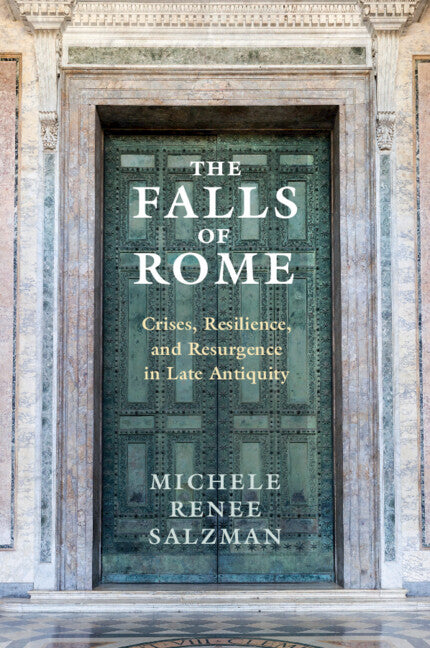
The Falls of Rome
Crises, Resilience, and Resurgence in Late Antiquity
Focuses on the resilience of generations of Roman men and women, and their ability to reconstitute their city and society.
Michele Renee Salzman (Author)
9781107529090, Cambridge University Press
Paperback / softback, published 12 September 2024
464 pages
22.8 x 15.1 x 2.8 cm, 0.7 kg
'This book makes it clear that the elite that continued to support the Old Capital did believe in the legacy of Rome and in the preservation of the values of Romanitas. Any scholar of late antique Rome will benefit from this book.' Massimiliano Vitiello, Speculum: A Journal of Medieval Studies
Over the course of the fourth through seventh centuries, Rome witnessed a succession of five significant political and military crises, including the Sack of Rome, the Vandal occupation, and the demise of the Senate. Historians have traditionally considered these crises as defining events, and thus critical to our understanding of the 'decline and fall of Rome.' In this volume, Michele Renee Salzman offers a fresh interpretation of the tumultuous events that occurred in Rome during Late Antiquity. Focusing on the resilience of successive generations of Roman men and women and their ability to reconstitute their city and society, Salzman demonstrates the central role that senatorial aristocracy played, and the limited influence of the papacy during this period. Her provocative study provides a new explanation for the longevity of Rome and its ability, not merely to survive, but even to thrive over the last three centuries of the Western Roman Empire.
1. Approaches to the fate of the Late Antique City
2. The Constantinian compromise
3. Responses to the sack of Rome in 410
4. Rome after the 455 vandal occupation
5. Why Gibbon was wrong
6. The fall of Ostrogothic Rome and the Justinianic reconstruction
7. The demise of the senate.
Subject Areas: Medieval European archaeology [HDDM], Medieval history [HBLC1], Early history: c 500 to c 1450/1500 [HBLC], Classical history / classical civilisation [HBLA1], Ancient history: to c 500 CE [HBLA]