Freshly Printed - allow 7 days lead
Couldn't load pickup availability
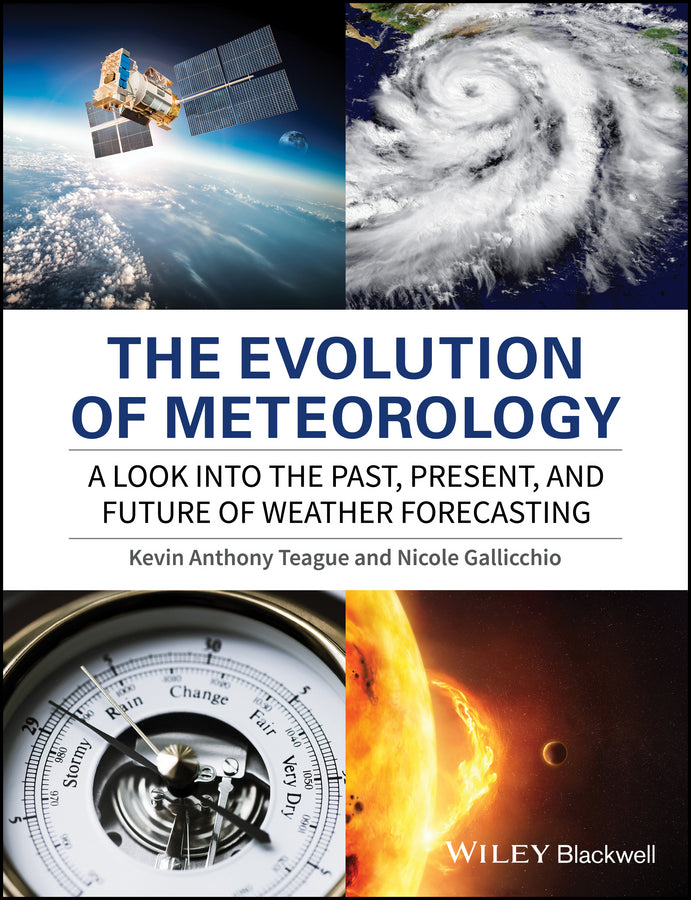
The Evolution of Meteorology
A Look into the Past, Present, and Future of Weather Forecasting
Kevin Anthony Teague (Author), Nicole Gallicchio (Author)
9781119136149, Wiley
Paperback / softback, published 21 July 2017
272 pages
24.4 x 18.8 x 1.5 cm, 0.612 kg
The essential guide to the history, current trends, and the future of meteorology This comprehensive review explores the evolution of the field of meteorology, from its infancy in 3000 bc, through the birth of fresh ideas and the naming of the field as a science, to the technology boom, to today. The Evolution of Meteorology reveals the full story of where meteorology was then to where it is now, where the field is heading, and what needs to be done to get the field to levels never before imagined. Authored by experts of the topic, this book includes information on forecasting technologies, organizations, governmental agencies, and world cooperative projects. The authors explore the ancient history of the first attempts to understand and predict weather and examine the influence of the very early birth of television, computers, and technologies that are useful to meteorology. This modern-day examination of meteorology is filled with compelling research, statistics, future paths, ideas, and suggestions. This vital resource: This enlightening text explores in full the history of the study of meteorology in order to bring awareness to the overall path and future prospects of meteorology.
About the Authors xiii Preface xv Acknowledgments xvii Section I Building Blocks of Meteorology (3000 bc–ad 1950) 1 1 Ancient Civilizations, Philosophical Theories, and Folklore (3000 bc–ad 1400) 3 1.1 Ancient Babylonians 3 1.2 Ancient Chinese 4 1.3 Aristotle and Meteorologica 4 1.4 Theophrastus and the Book of Signs 5 1.5 Ibn Wahshiyya and Nabataean Agriculture 6 1.6 William of Ockham and Nominalism 6 1.7 Religion, Folklore, and Animals 7 2 Inventions of Weather Instruments (1400–1800) 11 2.1 Rain Gauge 11 2.2 Hygrometer 12 2.3 Thermometer 13 2.4 Barometer 15 2.5 Anemometer 16 3 The Birth of Modern Meteorology (1800–1950) 19 3.1 Telegraph 19 3.2 Fitzroy 20 3.3 Hugo Hildebrand Hildebrandsson 20 3.4 Weather Balloons/Radiosondes 20 3.5 Birth of Governmental Weather Departments 22 3.6 Numerical Weather Prediction 25 3.7 Weather Broadcasting 26 3.8 Forecasting for WWII 26 3.9 Extreme Weather Forecasting: ‘Nowcasting’ 27 Section II The Early Television, Computer, Satellite, and Radar Era (1950–1980) 31 4 Television and the First Computerized Advancements 33 4.1 Television in the Household 33 4.2 Television Weather Forecasting of the 1950s 33 4.3 Television Weather Forecasting of the 1960s and 1970s 34 4.4 The Beginning of Computers and Numerical Weather Prediction (NWP) 35 4.5 Computers and NWP in the Met Office 37 4.6 Computers and NWP Worldwide 37 4.7 The 1970s and Its Lasting Influences on Forecasting 39 5 Radar and Satellite History 43 5.1 Invention of the Radar 43 5.2 Development of Weather Radar 44 5.3 Invention of the Satellite 46 5.4 Remote Sensing 46 5.5 Development of Weather Satellites 47 Section III Modern]Day Technologies, Advancements, and Social Media Impacts (1980–2013) 51 6 Personal Technology Boom 53 6.1 Television Networks 53 6.2 Personal Computers 55 6.3 The Internet and Meteorology 56 6.4 Cellphones and Social Media 56 6.5 Movies 58 7 Covering Major Storms 61 7.1 The Great Storm of 1987 61 7.2 Hurricanes and Tropical Cyclones 63 7.3 Tornadoes 66 7.4 Floods, Droughts, and Wildfires 68 7.5 Storm Chasing 70 7.6 Media 8 The Rise of Modern Computer Models 75 8.1 European Center for Medium]Range Weather Forecasting (ECMWF) 75 8.2 Main US Models 78 8.3 Specific Use Forecasting Models 79 8.4 Weather Research and Forecasting Model (WRF) 79 8.5 Global Data]Processing and Forecasting System (GDPFS) 80 8.6 Main Model Biases and Various Characteristics 80 9 Advancements within the Nationalized Governmental Weather Departments 87 9.1 The National Weather Service 87 9.2 The Met Office 91 9.3 Advancements across the World 93 9.4 Radar Development 96 9.5 New Satellite Developments 100 10 Meteorological Agencies at the Global and Private Level 107 10.1 World Government Agencies 107 10.2 Operations of World Organizations 110 10.3 Global Discussions 110 10.4 What a Private]Sector Weather Business Entails 111 10.5 Government vs. Private Sector 112 10.6 The Lesser]Known Services of the Private Sector 115 Section IV Current and Future Ideologies of Climate Change and Meteorological Processes 121 11 Climate Change 123 11.1 Climate Discussions 123 11.2 Earth’s Lifetime Fluctuations 125 11.3 Past Climate Data 127 11.4 Permafrost and Climate Change 130 11.5 Greenhouse Gases 132 11.6 The Intergovernmental Panel on Climate Change 133 12 Extreme Weather 141 12.1 Current Climate and Weather Trends 141 12.2 Classifying Extreme Weather 144 12.3 Extreme Weather Influences 147 12.4 Is Extreme Weather on the Rise? 150 12.5 Weather Pattern Predictions 153 13 Additional Meteorological Impacts 169 13.1 Space Weather 169 13.2 Earthquakes and the Effect on Climate Change 171 13.3 Weather and the Effects on the Human Body 172 14 Weather Technology 179 14.1 Tropical Cyclone Technology 179 14.2 Coastal Flooding 186 14.3 Extreme Weather 190 14.4 Enhancements to Radar, Satellite, and Model Output of Supercomputers 198 14.5 Long]Range Forecasting 203 14.6 Various Planned Advancements 203 15 Global Cooperation 211 15.1 Overall Global Forecasting 211 15.2 Global Networking in Meteorology 213 15.3 Disaster Management 215 15.4 Global Radar and Satellite Cooperation 220 15.5 Global Data]Processing and Forecasting Systems 221 15.6 Global Response to Climate Change 223 Appendix Figures A–H 231 Index 245
Kevin Anthony Teague
Nicole Gallicchio
Kevin Anthony Teague and Nicole Gallicchio
Kevin Anthony Teague
Nicole Gallicchio
Nicole Gallicchio
Nicole Gallicchio
Kevin Anthony Teague
Kevin Anthony Teague
Kevin Anthony Teague
Nicole Gallicchio
Nicole Gallicchio
Nicole Gallicchio
Kevin Anthony Teague
Kevin Anthony Teague
Subject Areas: Science: general issues [PD]