Freshly Printed - allow 10 days lead
Couldn't load pickup availability
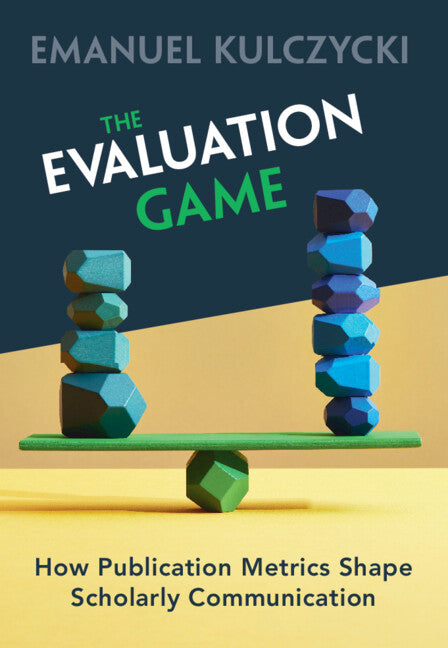
The Evaluation Game
How Publication Metrics Shape Scholarly Communication
This text examines the origin and effects of publication metrics that are used to measure academic productivity around the world.
Emanuel Kulczycki (Author)
9781009351188, Cambridge University Press
Hardback, published 27 April 2023
238 pages
25 x 17.5 x 1.8 cm, 0.57 kg
'… a valuable and exciting contribution.' Alessia Lo Porto Lefébure, Questions de communication
Scientific research is communicated, organized, financed, governed, and evaluated through the process of publication. The result of this process is a highly competitive academic environment that rewards researchers for high volume publication, preferably in high-impact journals, leading to the popularised expression 'publish or perish'. Universities and other scientific institutions are under similar pressure, with their aggregated research output being under constant scrutiny. This innovative text provides a detailed introduction to the origin and development of the scholarly metrics used to measure academic productivity, and the effect they have upon the quality and diversity of scientific research. With its careful attention to both the positive and negative outcomes of research evaluation and their distinct expressions around the globe, The Evaluation Game guides the way to a more grounded understanding of metrics, and the diverse academic cultures they give rise to.
Introduction
1. Evaluation as power
2. Economization and metricization
3. Untold histories of research evaluation
4. The diversity of evaluative powers
5. Players and the stakes
6. Playing the evaluation game
Conclusions
Acknowledgements
References
Index.
Subject Areas: Physics [PH]