Freshly Printed - allow 7 days lead
Couldn't load pickup availability
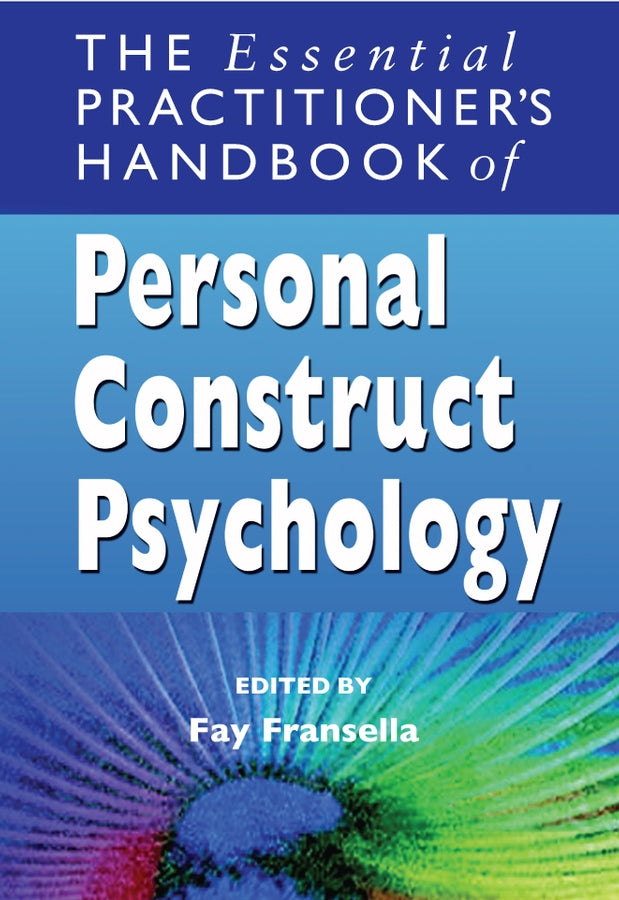
The Essential Practitioner's Handbook of Personal Construct Psychology
Fay Fransella (Edited by)
9780470013236, Wiley
Paperback / softback, published 11 March 2005
320 pages
24.8 x 17 x 1.8 cm, 0.51 kg
"...This book certainly lived up to its title as 'essential handbook'...very readable on a recreational level, yet challenging and thought-provoking on a professional level - a refreshing experience..." (The Psychologist, November 2005) "...very readable on a recreational level, challenging and thought-provoking on a professional level - a refreshing experience..." (Psychologist, November 05) "…extremely readable… challenging and extensive, making it a must read for all practitioners with an interest in Personal construct psychology." (The Journal of Critical Psychology, Counselling & Psychotherapy, Summer 2007)
This is a concise paperback version of the authoritative International Handbook of Personal Construct Psychology, focusing on the practical elements of that volume. Ideal for the individual practitioner, this selection of chapters covers the basic theory of personal constructs; the many skills and tools used by personal construct psychologists; its general application to psychotherapy and counselling; as well as many specific applications such as cross-cultural understanding, post-traumatic stress, children, teacher education, organizational change, nursing and family therapy. This is an indispensable guide to theory and skills for those wishing to use the personal construct psychology approach in their practice. It will appeal to a wide range of professionals such as psychologists, teachers, psychiatrists, nurses, system engineers and managers.
About the Editor ix International Advisory Panel xi List of Contributors xiii Preface xv Acknowledgements xvii Section I: What Personal Construct Psychology Is All About Chapter 1 George Alexander Kelly: The Man and his Theory 3 Chapter 2 The Logic of Passion 15 Chapter 3 The Power of a Good Theory 29 Section II: What Are Some of PCP’s Techniques? Chapter 4 Some Skills and Tools for Personal Construct Users 41 Chapter 5 A Range of Elicitation Methods to Suit Client and Purpose 57 Chapter 6 The Repertory Grid Technique 67 Chapter 7 Making Sense of Dependency 77 Chapter 8 Expertise and Expert Systems: Emulating Psychological Processes 87 Chapter 9 From Theory to Research to Change 95 Section III: How Can PCP Help Us to Understand People or Help Them to Change? Part 1: Working with the Individual or Individuals in Small Groups Chapter 10 Is Treatment a Good Idea? 109 Chapter 11 An Audacious Adventure: Personal Construct Counselling and Psychotherapy 113 Chapter 12 The Evidence Base for Personal Construct Psychotherapy 123 Chapter 13 Constructive Intervention with Children when Presented as Problems 133 Chapter 14 How Can We Understand One Another if We Don’t Speak the Same Language? 145 Chapter 15 Working with Anger 153 Chapter 16 An Approach to Post-Traumatic Stress 163 Chapter 17.1 Nursing 173 Chapter 17.2 Family Therapy 177 Chapter 17.3 The Metropolitan Police, London: A Personal Account 181 Chapter 17.4 A Sporting Use of Personal Construct Psychology 185 Chapter 17.5 Artificial Intelligence 189 Part 2: Working with Large Groups of People Chapter 18 Construing Teaching and Teacher Education Worldwide 195 Chapter 19 Making Sense of the ‘Group Mind’ 203 Chapter 20 Charting Organizational Change 213 Chapter 21 Clarifying Corporate Values: A Case Study 223 Section IV: Where Might Personal Construct Psychology Be Going Now? Chapter 22 Personal Construct Psychotherapy and the Constructivist Horizon 235 Chapter 23 New Avenues to Explore and Questions to Ask 245 Appendix 1 Theoretical Definitions 253 Appendix 2 Some Basic Books on Personal Construct Psychology 256 Appendix 3 Internet Resources for Personal Construct Psychology 259 References 263 Index 283
Fay Fransella and Robert A. Neimeyer
Don Bannister
Sean Brophy, Fay Fransella and Nick Reed
Fay Fransella
Pam Denicolo
Richard C. Bell
Beverly M.Walker
Mildred L.G. Shaw and Brian R. Gaines
Fay Fransella
George A. Kelly
Franz R. Epting, Marco Gemignani and Malcolm C. Cross
David Winter
Tom Ravenette
Devi Jankowicz
Peter Cummins
Kenneth W. Sewell
Julie M. Ellis, Jacqui Costigan and Julie Watkinson
Harry Procter
John Porter
David Savage
Jack Adams-Webber
Maureen Pope
Adrian Robertson
Nelarine Cornelius
Sean Brophy
Robert A. Neimeyer and Scott A. Baldwin
Fay Fransella
Brian R. Gaines
Subject Areas: Psychology [JM]