Freshly Printed - allow 7 days lead
Couldn't load pickup availability
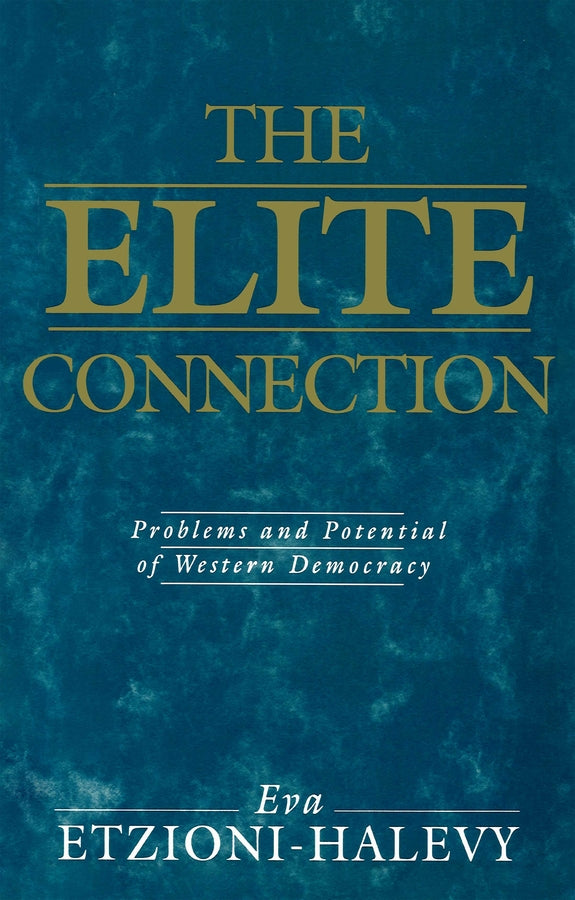
The Elite Connection
Problems and Potential of Western Democracy
Amitai Etzioni (Author)
9780745610689, Polity Press
Paperback / softback, published 24 December 1992
260 pages
23 x 15.2 x 1.8 cm, 0.381 kg
Designed as a textbook for courses in political theory, political sociology and comparative politics, and as a contribution in its own right, this book explores the role of elite relations as a key to understanding democracy. Following a critical review of the literature on classes, democracy and elites, the author argues that although Western democracy is not `governed by the people' and has not created equality, it is unique in that (more than any other regime) it has generated a relative separation of power holders, or a relative autonomy of elites and sub-elites in the control of resources. Developing this argument the author discloses strengths and weaknesses in democracy's infrastructure. The Elite Connection contains a warning that a major danger to democracy stems from the tendency of elites to make incursions into the autonomy of other elites, and to develop excessively close dependency relations, either in subjugation of them, or in collusion with them, which result in threats to civil liberties and to the very foundations of democracy. It argues, however, that democracy has the built-in potential to counter its own subversions. Although it focuses on elites, the book has an egalitarian perspective: it concludes with the argument that the separation of elites makes possible struggles for greater equality. The still relatively independent elites of social movements have the potential of pushing democracy towards greater participation and equality.
Acknowledgements. Introduction. Part I: Elites and Classes: Bringing Elites Back In. 1. Why Class Theory has Overshadowed Elite Theory: A Matter of Coincidence. 2. Why Class Theory Should not have Overshadowed Elite Theory: A Matter of Democracy. Part II: The Autonomy of Elites and Western thought. 3. Democratic Elite Theory. 4. Other Theories: A Comparison. Part III: The Demo-Elite Perspective. 5. The Autonomy of Elites and Democracy. 6. Elite Autonomy Versus Co-operation and the Historical Development of Democracy. Part IV: The Autonomy of Elites and the Success (or Failure) of Democracy. 7. Stabilization Versus Breakdown of Democracy: The Cases of Britain and Germany. 8. Problems of Transition to Democracy in eastern Europe: The Cases of the Soviet Union and Poland. Part V: Meanwhile in the West: Problems and Potential of Democracy. 9. Elite Autonomy Under Siege and Problems of Western Democracy. 10. Social Protest Movements and the Potential of Western Democracy. Conclusion. References.
Subject Areas: Philosophy [HP]