Freshly Printed - allow 10 days lead
Couldn't load pickup availability
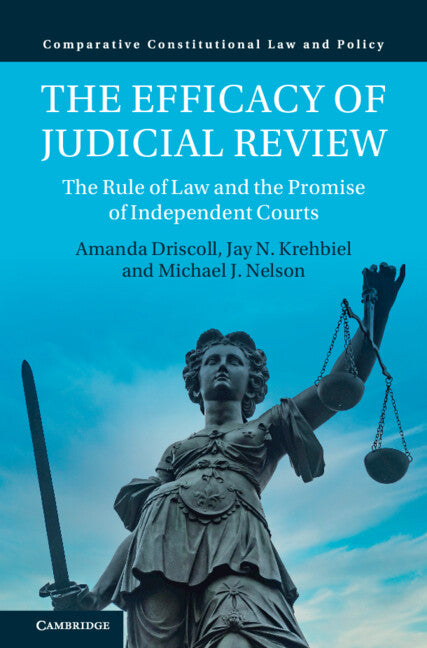
The Efficacy of Judicial Review
The Rule of Law and the Promise of Independent Courts
Explains when, where, and how constitutional courts help citizens hold executives to account and protect the rule of law
Amanda Driscoll (Author), Jay N. Krehbiel (Author), Michael J. Nelson (Author)
9781009388924, Cambridge University Press
Hardback, published 4 September 2025
308 pages
23.5 x 16 x 2.2 cm, 0.6 kg
Over the past century, countries around the globe have empowered constitutional courts to safeguard the rule of law. But when can courts effectively perform this vital task? Drawing upon a series of survey experiments fielded in the United States, Germany, Hungary, and Poland, this book demonstrates that judicial independence is critical for judicial efficacy. Independent courts can empower citizens to punish executives who flout the bounds of constitutional rule; weak courts are unable to generate public costs for transgressing the law. Although judicial efficacy is neither universal nor automatic, courts – so long as they are viewed by the public as independent – can provide an effective check on executives and promote the rule of law.
1. The promise of judicial review
2. Theorizing judicial efficacy
3. How, when, and where to evaluate judicial efficacy
4. Measuring public support for the rule of law
5. How judicial independence facilitates State constraint
6. Citizens' convictions and judicial review
7. Judicial review Amid partisan publics
8. Do partisan litigants weaken judicial efficacy?
9. The prospects of judicial review
Bibliography.
Subject Areas: Constitutional & administrative law [LND]