Freshly Printed - allow 10 days lead
Couldn't load pickup availability
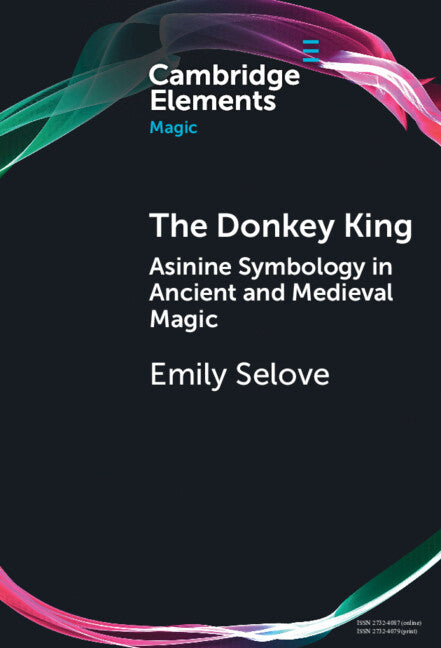
The Donkey King
Asinine Symbology in Ancient and Medieval Magic
Asinine Symbology, focused on the phallus and the bray, has a double-edged potency that renders donkeys powerful in magic.
Emily Selove (Author)
9781009462549, Cambridge University Press
Hardback, published 21 December 2023
74 pages
23.5 x 15.9 x 1 cm, 0.26 kg
The 13th-century Arabic grimoire, al-Sakkākī's Kitāb al-Shāmil (Book of the Complete), provides numerous methods of contacting jinn. The first such jinn described, Abū Isrā'īl Būzayn ibn Sulaymān, arrives with a donkey. In the course of offering an explanation for his ritual, this Element reveals the double-sided nature of asinine symbology, and explains why this animal has served as the companion of both demons and prophets. Focusing on two nodes of donkey symbology—the phallus and the bray-it reveals a coincidentia oppositorum in a deceptively humble and comic animal form. Thus, the donkey, bearer of a demonic voice, and of a phallus symbolic of base materiality, also represents transcendence of the material and protection from the demonic. In addition to Arabic literature and occult rituals, the Element refers to evidence from the ancient Near East, Egypt, and Greece, as well as to medieval Jewish and Christian texts.
Preface
1. Introduction: the complete donkey
2. The ancient donkey and his afterliv
3. The phallus of the donkey
4. The voice of the donkey
5. Conclusion
Bibliography.
Subject Areas: Religion: general [HRA]