Freshly Printed - allow 10 days lead
Couldn't load pickup availability
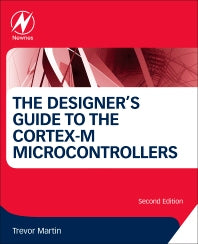
The Designer's Guide to the Cortex-M Processor Family
Choose the right ARM Cortex-M architecture for your application and learn how to program your applications in C
Trevor Martin (Author)
9780081006290
Paperback / softback, published 9 June 2016
490 pages, Approx. 195 illustrations
23.4 x 19 x 3.1 cm, 0.66 kg
The Designer’s Guide to the Cortex-M Microcontrollers gives you an easy-to-understand introduction to the concepts required to develop programs in C with a Cortex-M based microcontroller. The book begins with an overview of the Cortex-M family, giving architectural descriptions supported with practical examples, enabling you to easily develop basic C programs to run on the Cortex-M0/M0+/M3 and M4 and M7. It then examines the more advanced features of the Cortex architecture such as memory protection, operating modes, and dual stack operation. Once a firm grounding in the Cortex-M processor has been established the book introduces the use of a small footprint RTOS and the CMSIS-DSP library. The book also examines techniques for software testing and code reuse specific to Cortex-M microcontrollers. With this book you will learn: the key differences between the Cortex-M0/M0+/M3 and M4 and M7; how to write C programs to run on Cortex-M based processors; how to make the best use of the CoreSight debug system; the Cortex-M operating modes and memory protection; advanced software techniques that can be used on Cortex-M microcontrollers; how to use a Real Time Operating System with Cortex-M devices; how to optimize DSP code for the Cortex-M4; and how to build real time DSP systems.
1. Introduction to the Cortex-M processor family 2. Developing software for the Cortex-M family 3. Cortex-M Architecture 4. Cortex Microcontroller Software Interface Standard 5. Advanced Architectural features 6. Cortex-M7 Architecture 7. Debugging with CoreSight 8. Practical DSP for the Cortex-M4 9. Developing with CMSIS-RTOS 10. Practical RTOS Techniques 11. Test Driven Development 12. Designing Software Components 13. Closing Thoughts
Subject Areas: Information technology: general issues [UB], Electronic devices & materials [TJFD], Electronics & communications engineering [TJ]