Freshly Printed - allow 8 days lead
Couldn't load pickup availability
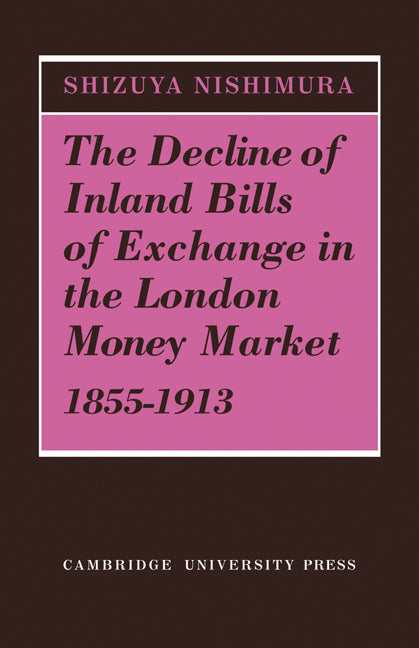
The Decline of Inland Bills of Exchange in the London Money Market 1855–1913
This book discusses how inland bills of exchange declined in the years of 1855–1913.
Shizuya Nishimura (Author)
9780521131476, Cambridge University Press
Paperback, published 18 February 2010
144 pages
21.6 x 14 x 0.9 cm, 0.19 kg
This 1971 book reviews and criticises the widely accepted hypothesis that the decline of the inland bill of exchange in Britain in the nineteenth century was largely due to the process of bank amalgamation, which linked bank branches in areas of excess demand for money with branches having surplus funds. Dr Nishimura argues that the introduction of the telegraph and steamship in the last quarter of the nineteenth century, by making both supply and demand more certain, relieved the merchant of the necessity to hold large stocks of goods in anticipation of orders. This book will be useful for other researchers in this field.
List of tables and figures
Preface
Notes
Introduction
1. Bank offices in England and Wales, 1855–1913
2. Estimated amounts of bills drawn, 1855–1913
3. Average usance of bills
4. Re-discounts of bills by local banks
5. Bank overdrafts and cash payment
6. Some consequences of the decline of inland bills
Conclusions
Tables
Figures
Bibliography
Index.
Subject Areas: History [HB]