Freshly Printed - allow 10 days lead
Couldn't load pickup availability
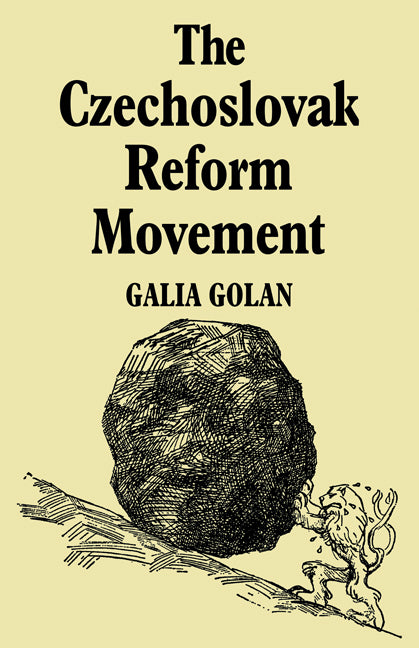
The Czechoslovak Reform Movement
Communism in Crisis 1962–1968
The `Prague Spring' was but the climax of a long, intensive struggle waged within the Czechoslovak party and society since 1956.
Galia Golan (Author)
9780521085694, Cambridge University Press
Paperback / softback, published 14 October 2008
360 pages
21.6 x 13.9 x 1.9 cm, 0.48 kg
In 1968 the Czechoslovak Communist Party undertook an experiment which might well have rejuvenated and inspired the prospects for Communism at least in the Western world. This `Prague Spring' was but the climax of a long, intensive struggle waged within the Czechoslovak party and society since 1956 and, most consistently, since the decision of the 12th Congress of the Czechoslovak Communist Party to instigate 'de-Stalinization' in December 1962. The struggle itself became a powerful movement for reform, winding its way inexorably throughout the Czechoslovak party and society in the years 1962 to 1968. Galia Golan traces this struggle in every sphere of Czechoslovak society – the economy, the mass organizations, the cultural world, the government, the minorities, the realm of idelogy - from its early victories over the conservative Communist leadership in 1962–3, through its ascent to power and conversion to a mass movement in 1968 until its suppression on 21 August 1968.
Part I. Introduction: 1956 to 1962: Part II. Events of 1963 – The Decision to De-Stalinize: 1. The Twelfth Party Congress and its Background
2. Revolt of the Intellectuals
3. Regime Response and Crisis
Part III. Economic Reforms: 4. Principles of the New System
5. Planning and Organization of Industrial Production
6. Economic Levers in the Industrial Sector
7. Reforms in Other Spheres of the Economy
Part IV. Reforms in the Social-Cultural Spheres: 8. Mass Organizations
9. Education
10. The Arts
11. Mass Communications
Part V. Political Reforms: 12. Ideology and the Party
13. Elected Organs of Government
14. Slovakia
15. Legal System
Part VI. Events of 1967 – The Liberals Come to Power: 16. Pressures from the Economists
17. Pressures from the Cultural World
18. Pressures from the Slovaks and the Youth
19. The Pressures Come to a Head
Part VII. Epilogue – January to August 1968: 20. An End and a Beginning
21. Economic Reforms
22. Social Organizations and Cultural Life
23. Political Reforms
24. Invasion.
Subject Areas: General & world history [HBG]