Freshly Printed - allow 10 days lead
Couldn't load pickup availability
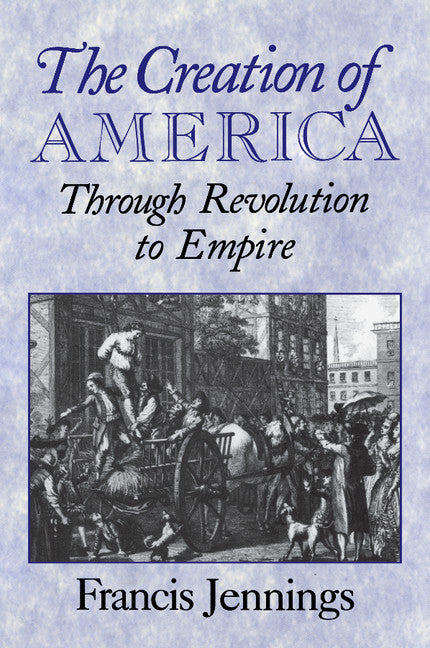
The Creation of America
Through Revolution to Empire
This alternative history of the American Revolution, first published in 2000, shows the colonists as empire-building conquerors rather than democratic revolutionaries.
Francis Jennings (Author)
9780521664813, Cambridge University Press
Paperback / softback, published 31 July 2000
354 pages
22.8 x 15.3 x 2.6 cm, 0.485 kg
"a remarkable set of very engaging stories...Founding Brothers is a wonderful book, one of the best collections of essays on the Founders ever written." N.Y. Review of Books March 01
In the standard presentation of the American Revolution, a ragtag assortment of revolutionaries, inspired by ideals of liberty and justice, throw off the yoke of the British empire and bring democracy to the New World. In place of this fairy tale, Francis Jennings presents a realistic alternative: a privileged elite, dreaming of empire, clone their own empire from the British. This book, first published in 2000, shows that the colonists intended from the first to conquer American Indians. Though subordinate to the British crown, the colonists ruled over beaten native peoples. Some colonists bought Africans as slaves and rigidly ruled over them, and the colonists invented racial gradation to justify conquests and oppression. Jennings reveals as war propaganda the revolutionary rhetoric about liberty and virtue. Including the whole population in this meticulously documented history, Jennings provides an eloquent explanation for a host of anomalies, ambiguities, and iniquities that have followed in the American Revolution's wake.
Part I. England Extends Conquests to North America: 1. Preface
2. Origins
3. Embryonic empires
4. Dependencies: Indians, The West
5. Colonial variety I: Virginia
6. Colonial variety II: New England
7. Colonial variety III: New York
8. Colonial variety IV: Pennsylvania
9. Colonial variety V: South Carolina
Part II. Frictions Arise Within The Empire: 10. 'Salutary neglect'
11. Royal prerogative in America
12. War in principle
13. Irritants
14. At the core
15. George III
16. Reactions becoming revolution
17. A variation on the theme of liberty
18. Repression and resistance
19. A battle for bishops
Part III. An American Clone Breaks Off: 20. Imperial and colonial frontiers
21. Changing sides
22. Defiance and crackdown
23. Uniting for liberty, tentatively
24. Shots heard round the world
25. Multiple revolutions
26. Decision
27. Religion then and now
28. A 'people's democracy'
29. Liberty, virtue, empire
30. Conquest, slavery, race
31. Combat: multiple outbreaks
32. Combat: the western theatre, I
33. Combat: the northern theatre, I
34. Combat: the northern theatre, II
35. Saratoga
36. Combat: the western theatre, II
37. 'West' in the middle
38. Combat: the southern theatre
39. Yorktown
Part IV. The Clone Establishes its Form: 40. What next?
41. Land
42. People
43. Power
Part V. More Conquests: 44. Climax
45. In sum.
Subject Areas: Early modern history: c 1450/1500 to c 1700 [HBLH], History of the Americas [HBJK]