Freshly Printed - allow 7 days lead
Couldn't load pickup availability
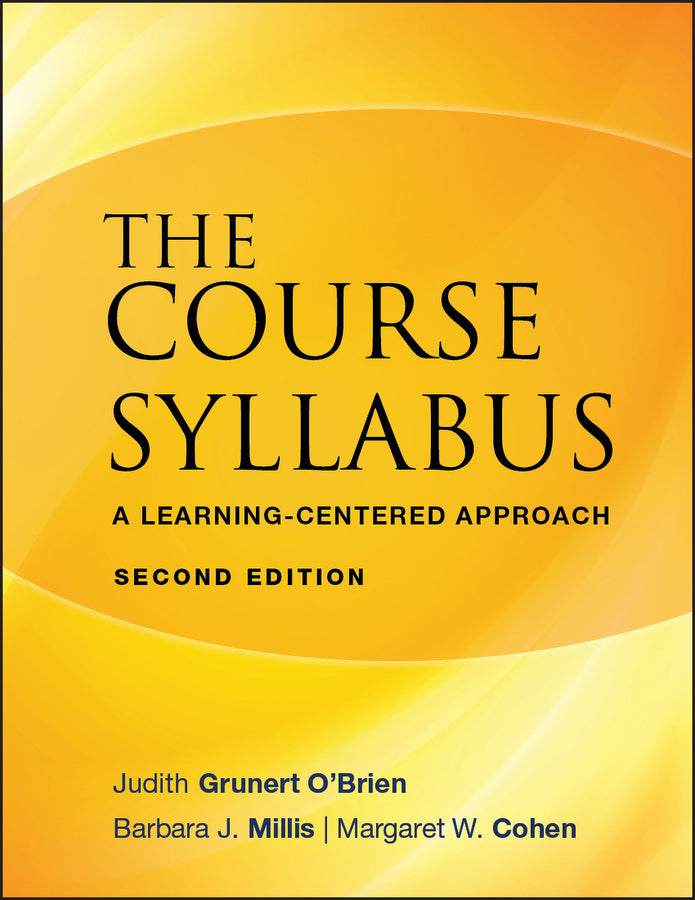
The Course Syllabus
A Learning-Centered Approach
“I can’t imagine how many times I’ve recommended this book—to new faculty, to part time teachers, to experienced pedagogues and faculty finding their way to more learner-centered approaches. I can’t imagine a book more deserving of a second edition. And, I can’t imagine a second edition better than the first, but this one is, thanks to the able efforts of two new authors.” “New and veteran college teachers alike, in all types of institutions from the community college to the university level, will benefit from this highly thoughtful, scholarly and persuasive argument for the critical role of the ‘learning-centered’ course syllabus. The authors clearly and convincingly demonstrate how to create a learning-centered course syllabus that becomes a dynamic, essential part of a course that encourages student engagement, active learning, and critical thinking. A ‘must read’ for anyone committed to teaching today’s college students to maximize their skills and knowledge for a changing world!” “It’s obvious that Millis and Cohen have extensive backgrounds in college teaching and learning. Their work on the syllabus as a fundamental component of good teaching is supportive, insightful, current, and practical. This is a masterful updating of Grunert’s classic, relevant across all disciplines.” “All individuals involved in instructing today’s (and tomorrow’s) college students facing twenty-first century academic challenges should read this book for helpful suggestions on how to prepare an enhanced blueprint for learning and academic success—the course syllabus.” “This book is unusually good. Comprehensive, clear, practical, and immediately useful, it should be read by every department chair and faculty member.” “This update of The Course Syllabus includes, among other fine features, an excellent review and incorporation of ideas from the literature on college teaching that have been published since the original version.” “The syllabus is much more than a course description; it is a working document for both the instructor and the students. In The Course Syllabus, Grunert, Millis and Cohen have provided a well-documented, very up to date road map for using it effectively by teachers and learners alike, by emphasizing the value of the learner-centered approach.”
--Maryellen Weimer, professor emeritus, Penn State, editor, the Teaching Professor
--Angela Provitera McGlynn, professor emeritus of psychology and author of Teaching Today’s College Students and Successful Beginnings for College Teaching
--Nancy Chism, Professor of Higher Education, Indiana University
--James E. Groccia, director, Biggio Center for the Enhancement of Teaching and Learning; associate professor, Educational Leadership; and past president, POD Network in Higher Education
--Peter Seldin, Ph.D., Distinguished Professor of Management, Pace University
--L. Dee Fink, national project director, Teaching & Curriculum Assessment Project
--Marilla D. Svinicki, Ph.D., professor, Department of Educational Psychology, The University of Texas at Austin
Judith Grunert O'Brien (Author), Barbara J. Millis (Author), Margaret W. Cohen (Author), Robert M. Diamond (Foreword by)
9780470197615, Wiley
Paperback / softback, published 29 April 2008
160 pages
27.7 x 21.3 x 1 cm, 0.386 kg
When it was first published in 1997, The Course Syllabus became the gold standard reference for both new and experienced college faculty. Like the first edition, this book is based on a learner-centered approach. Because faculty members are now deeply committed to engaging students in learning, the syllabus has evolved into a useful, if lengthy, document. Today's syllabus provides details about course objectives, requirements and expectations, and also includes information about teaching philosophies, specific activities and the rationale for their use, and tools essential to student success.
Foreword xi Preface xiii Acknowledgments xvii The Authors xix Part I: Focus On Learning Preparing Students 3 Setting a Framework for Knowledge 4 Planning Your Learning-Centered Syllabus: An Overview of the Process 13 Composing a Learning-Centered Syllabus 21 Using a Learning-Centered Syllabus 34 Part II: Examples Checklist 39 Table of Contents 40 Instructor Information 41 Student Information Form 43 Letter to the Students or Teaching Philosophy Statement 44 Purpose of the Course 49 Course Description 51 Course Objectives 54 Readings 63 Resources 65 Course Calendar 67 Course Requirements 71 Policies and Expectations: Attendance, Late Papers, Missed Tests, Class Behaviors, and Civility 77 Policies and Expectations: Academic Integrity, Disability Access, and Safety 87 Evaluation 92 Grading Procedures 98 How to Succeed in the Course: Tools for Study and Learning 102 Part III: Suggested Readings General Teaching 111 Active Learning 112 Assessment and Evaluation 113 Cooperative and Collaborative Learning 113 Course and Curriculum Design 114 Critical Thinking 115 Information Technology 115 Learning and Motivation 116 Student Differences 116 Online Resources for Syllabus Construction 118 Teaching Portfolios 118 References 121 Index 127
Subject Areas: Education [JN]