Freshly Printed - allow 7 days lead
Couldn't load pickup availability
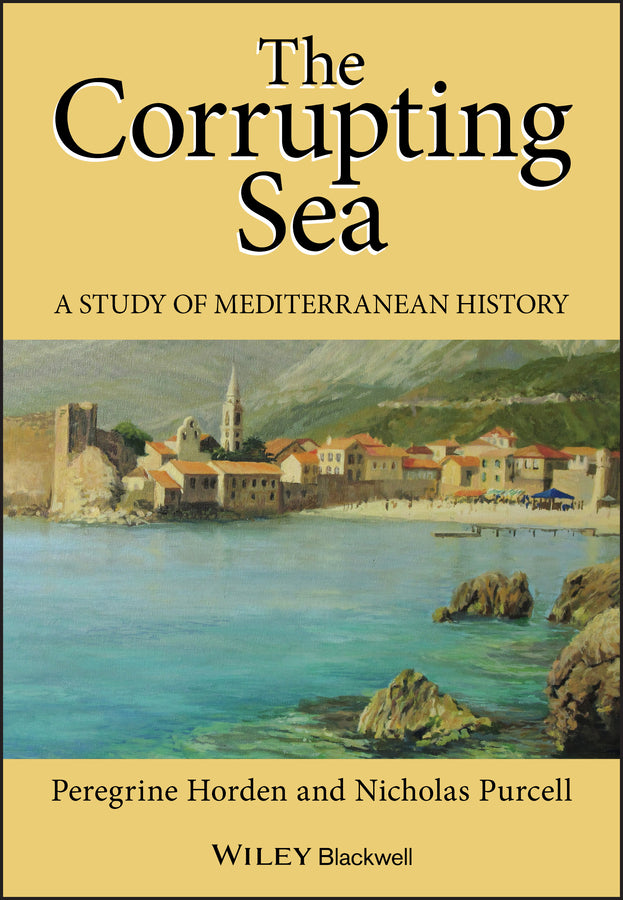
The Corrupting Sea
A Study of Mediterranean History
Peregrine Horden (Author), Nicholas Purcell (Author)
9780631218906, Wiley
Paperback / softback, published 14 January 2000
784 pages
24.1 x 16.5 x 4.3 cm, 1.293 kg
"The Corrupting Sea is a book that all classicists should read." Classical Review "In their book The Corrupting Sea, Horden and Purcell have engaged in one of the most relentless intellectual reassessments to have been undertaken in recent times of the history of the pre-industrial Mediterranean. One seldom emerges from a book as rich as this, having had so many firmly-held notions shaken out of one's mind and having glimpsed so many enthralling new vistas on a once-familiar past." Professor Peter Brown, Princeton University "To bring together the economic and social history of so many periods and places within the great story of the Mediterranean is a remarkable achievement and Peregrine Horden and Nicholas Purcell should be congratulated upon it." Professor Colin Renfrew, McDonald Institute for Archaeological Research, University of Cambridge "In recreating the Mediterranean for the new millennium, the authors offer a substantial achievement that challenges many long-held assumptions not only about the Mediterranean, but also about human relations with the environment and even the very nature of historical writing. It certainly deserves to provoke discussion among scholars from fields as broad as its own grand scope." Times Higher Education Supplement "The Corrupting Sea is a book of magisterial synthesis and scholarship - a huge multi-disciplinary literature turned into a narrative that is at once comprehensive, enjoyable, quirky and thought-provoking." Antiquity "This book will be indispensable for the serious student of the Mediterranean past and present." CHOICE "This is an important book that presents a powerful and original model of Mediterranean history that will be used, debated, and criticized by historians of all periods for years to come." English Historical Review "Horden and Purcell's new Mediterranean panorama, which will take a generation of historians to digest and implement, forms one of those manifest watersheds in the study of antiquity." Journal of Roman Archaeology "This book amounts to an often fascinating, and unerringly useful, compendium." International History Review "Here a generation of ecological historians ... has led the way. Horden and Purcell have synthesized that literature, extended its reach into the Middle Ages, and made it accessible to the general medievalist." Speculum "This impressive work synthesizes a vast amount of historical, geographical, archaelogical, and ethnographic knowledge about the Mediterranean region." Historical Geography
The Corrupting Sea is a history of the relationship between people and their environments in the Mediterranean region over some 3,000 years. It offers a novel analysis of this relationship in terms of microecologies and the often extensive networks to which they belong.
List of Maps vii Acknowledgements ix Note on References x Abbreviations xi Introduction 1 Part One: ‘Frogs round a Pond’: Ideas of the Mediterranean 7 I A Geographical Expression 9 1. What is the Mediterranean?;2. The Challenge of the Continents;3. The Mediterranean Disintegrated; 4. Intimations of Unity II a Historian’s Mediterranean 26 1. The Imaginary Sea; 2. Four Men in a Boat; 3. The End of the Mediterranean; 4. Mediterranean History; 5. Historical Ecology Part Two: ‘Short Distances and Definite Places’: Mediterranean Microecologies 51 III Four Definite Places 53 1. The Biqa; 2. South Etruria; 3. The Green Mountain, Cyrenaica; 4. Melos; 5. ‘La trame du monde’; 6. Mountains and Pastures; 7. Theodoric and Dante IV Ecology and the Larger Settlement 89 1. An Urban Tradition; 2. Definitions; 3. The Urban Variable; 4. Types and Theories; 5. Consumption; 6. Settlement Ecology; 7. Autarky; 8. Dispersed Hinterlands V Connectivity 123 1. Lines of Sound and Lines of Sight; 2. Extended Archipelagos; 3. Shipping Lanes; 4. Economies Compared; 5. The Early Medieval Depression; 6. Connectivity Maintained?; 7. Conclusion Copyrighted Material Part Three: Revolution and Catastrophe 173 VI Imperatives of Survival: Diversify, Store, Redistribute 175 1. The History of Mediterranean Food Systems; 2. The New Ecological Economic History; 3. Understanding the Marginal; 4. The Integrated Mediterranean Forest; 5. The Underestimated Mediterranean Wetland; 6. ‘These Places Feed Many Pickling-Fish .’; 7. Mediterranean Animal Husbandry; 8. Cereals and the Dry Margin; 9. The Case of the Tree-Crop; 10. The Mediterranean Garden; 11. The Smaller Mediterranean Island VII Technology and Agrarian Change 231 1. Working the Soil; 2. The Irrigated Landscape; 3. On the Diversity of Cultivated Plants; 4. Abatement and Intensification; 5. Anatomy of the Mediterranean Countryman; 6. Colonizations and Allotments; 7. The Reception of Innovation VIII Mediterranean Catastrophes 298 1. On the History of Catastrophe; 2. An Unstable World; 3. Alluvial Catastrophe and its Causes; 4. Sediments and History; 5. The History of Vegetation; 6. Environmental History without Catastrophe IX Mobility of Goods and People 342 1. Inescapable Redistribution; 2. Animal, Vegetable and ; 3. The Problem of Mediterranean Textiles; 4. Problems with High Commerce; 5. The Ultimate Resource; 6. Organized Mobility; 7. Places of Redistribution Part Four: The Geography of Religion 401 X ‘territories of Grace’ 403 1. Religion and the Physical Environment; 2. A Perilous Environment; 3. The Sacralized Economy; 4. The Religion of Mobility; 5. The Religion of Boundary and Belonging Part Five: ‘Museums of Man’? The Uses of Social Anthropology 461 XI ‘mists of Time’: Anthropology and Continuity 463 1. Survivals Revisited; 2. Balanced Arcadias; 3. The Presence of the Past; 4. Upstreaming XII ‘i also Have a Moustache’: Anthropology and Mediterranean Unity 485 1. Grands faits méditerranéens?; 2. Mediterranean Values?; 3. Honour and Shame I; 4. Honour and Shame II; 5. Honour in the City; 6. Pattern and Depth; 7. Distinctiveness; 8. Origins; 9. History; 10. The Case for Mediterraneanism Bibliographical Essays 530 Consolidated Bibliography 642 Index 737
Subject Areas: History [HB]