Freshly Printed - allow 7 days lead
Couldn't load pickup availability
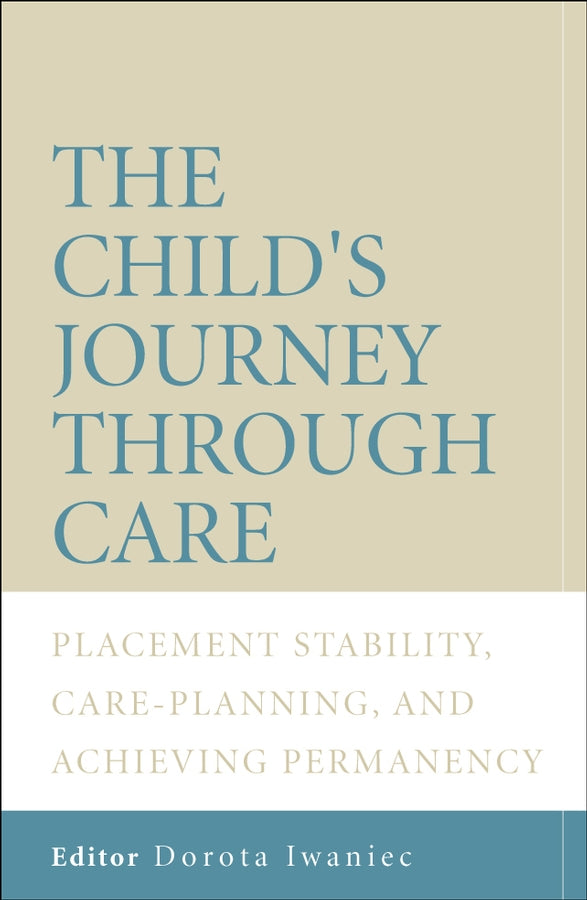
The Child's Journey Through Care
Placement Stability, Care Planning, and Achieving Permanency
Dorota Iwaniec (Edited by)
9780470011379, Wiley
Hardback, published 28 July 2006
304 pages
24.9 x 17.5 x 2.2 cm, 0.709 kg
“…a consistent style that makes some complex issues quite accessible…if you’ve only got time for one book about care, this could be it.” (Children Now, April 2007)
This book focuses on children's journeys through the care system, from voluntary admission into care, through complicated and often long court proceedings, in pursuit of Care or Freeing Orders. Problems that arise from taking cases through the courts are examined, together with tensions that may arise between judicial and social work decision-making. The Child's Journey Through Care discusses in full: The book also includes considerations of the European Convention of Human Rights (1998) and describes many of the dilemmas arising in meeting the rights of children and parents, without jeopardising the welfare of either. The importance of openness, consideration, and straightforward dealings with parents is given due emphasis, especially where preparations for taking cases to court are involved. The Child's Journey Through Care will be a valuable source of information for field and residential workers, social work supervisors, resource managers, policy makers, and those working in the legal profession.
List of Illustrations xi About the Contributors xiii Preface xvii Editor's Acknowledgements xix Part I The Need for a Good Start in Life: Attachment, Bonding, and Children's Rights 1 1 Introduction: An Overview of Children in Public Care 3 Introduction 3 Problems and Dilemmas with Fostering and Residential Care 5 Looked-after Children in the United Kingdom 8 Abuse of Children in Care 10 The Purpose and Organisation of the Book 11 References 14 2 Ordinary Children in Extraordinary Circumstances 17 Introduction 17 Children in Need 17 Recent Child-development Thinking 18 The Ecological Perspective 19 Recognising the Uniqueness of Individual Children 20 The Well-ness Approach 21 Resilience and Strengths 21 An Optimistic View of Child Development 22 Children as Actors in their Own Development 23 Aspects of Children's Development of Special Relevance to Looked-after Children 24 Children's Attachments 24 What Is Attachment? 25 Children and Multiple Attachments 26 Continuities and Discontinuities of Working Models 27 The Impact of Loss on Children's Development 28 Counteracting the Impact of Loss and Separation with Contact and Connectedness 30 Attachments and Socio-genealogical Connectedness 31 Counteracting the Impact of Separation with Stability 32 A Permanency Planning Approach 33 What Can Help Promote Children's Development in Practice? 33 References 35 3 The Importance of Developing Emotional Bonds between Parents and Children 41 Introduction 41 What Is Bonding? 41 Bonding and Attachment 43 What Influences the Bonding Process? 44 The Bonding Process and Care Careers 48 Facilitating the Bonding Process for Alternative Care-providers 53 Summary 54 References 55 4 Children in Alternative Care: Are their Rights Being Met? 61 Introduction 61 Children's Rights 62 Articles Associated with Alternative Care 63 Processes Leading to Care Orders 65 Care Orders 66 Foster Care 67 Residential Care 69 Secure Accommodation 71 Conclusion 73 Acknowledgements 75 Notes 75 References 75 Part II Pathways to Permanency 79 5 Outcomes of Long-term Foster Care: Young People's Views 81 Introduction 81 Improving Outcomes for Looked-after Children 82 Outcomes of Long-term Foster Care 83 Children's Rights and Researching Children's Views 84 The Pathways and Outcomes Study 85 Interviews with the Young People: Key Messages 86 Implications for Policy and Practice 92 Conclusion 93 References 94 6 Kinship Care as a Route to Permanent Placement 99 Introduction 99 Children Cared For by the Kinship and Traditional Foster Parents 100 The Placement of Children in Kinship Foster Care 102 The Motivation of Kinship Carers 102 Contact between the Children and their Birth-families 104 Contact with Birth-fathers 105 Kinship Foster Carers and Contact 105 Relationship between Birth-mother and Fostering Household 106 Care Plans 108 Adoption 109 Residence Orders 109 Conclusion 110 References 112 7 Exploring Regional Trends in Pathways to Permanency 113 Introduction 113 Placement Trends in Northern Ireland: Policy and Practice 114 Placement Trends in Northern Ireland: Statistical Information 116 Research on Regional Placement Variation 117 Examining Regional Variations 119 Variations in Placement Patterns over Time 120 Discussion of Results 124 Conclusion 127 Acknowledgements 127 References 128 Part III Residential and Mixed Care 131 8 Developments in Residential Care in Northern Ireland 133 Introduction 133 Setting the Context for Change – Residential Care in England and Wales 134 Setting the Context for Change – Residential Care in Northern Ireland 137 Discussion 140 Conclusion 142 Acknowledgements 143 Note 143 References 143 9 The Mental-health Needs of Looked-after Children 147 Introduction 147 Looked-after Children and Mental Health 148 Understanding Looked-after Children's High Levels of Mental-health Needs 152 Are We Meeting the Mental-health Needs of Looked-after Children? 155 Models of Mental-health Service Delivery to Looked-after Children 158 Conclusion 161 References 163 10 Changing Lives or Just Changing Location? Planning for Adolescents in Substitute Care 169 Introduction 169 Background 169 The Planning Process for Children Placed in Residential or Foster Care 171 Conclusion 178 References 179 11 Making Use of Positive Psychology in Residential Child Care 183 Introduction 183 An Introduction to Positive Psychology 185 Goleman and 'Emotional Intelligence' 188 Therapeutic Aspects of 'Emotional Intelligence' 190 Csikszentmihalyi and 'Flow' 193 Therapeutic Aspects of 'Flow' 196 Conclusion: Positive Psychology at Work 197 References 199 Part IV Court and Family Support Pathways to Substitute Care 201 12 Pathways to Permanence: Accommodation, Compulsion, and Permanence under the Children (NI) Order (1995) 203 Introduction 203 The Study 205 Care Order Application or Accommodation? 207 Parents' 'Co-operation' 210 Implications for Permanence Planning 215 References 217 13 Care Planning in Care Proceedings: A Case Study Perspective on Achieving Permanency 219 Introduction 219 Care Planning 220 Parallel Planning 220 Concurrent Planning 221 Permanency Planning and Attachment 221 Case Studies 222 Discussion 230 Acknowledgements 232 References 232 14 The Participation of Looked-after Children in Public Law Proceedings 235 Introduction 235 Who Are Looked-after Children? 236 Looked-after Children and Public Law Proceedings 237 Definitions of Participation 238 Reasons for the Increased Emphasis on Participation 239 Mechanisms and Provisions for the Participation of Looked-after Children in Public Law Proceedings 240 Effectiveness of Existing Mechanisms and Provisions Regarding the Participation of Looked-after Children in Public Law Cases 242 Room for Improvement 244 Ways Forward 246 Conclusion 251 References 251 Part V Messages from Research 257 15 Messages from Research 259 Introduction 259 Pathways to Permanency 259 Kinship Care 261 Permanency through Adoption 262 Building Attachments and Bonding 263 Children's Rights and Participation of Children in Public Law Proceedings 264 Care Planning, Assessment, and Intervention 266 Legal and Voluntary Pathways to Substitute Care 267 Difficulties and Costs of Legal Proceedings 268 Conclusion 269 References 270 Index 273
Dorota Iwaniec
Jane Aldgate
Emma Larkin
Rosemary Kilpatrick
Colette McAuley
Una Lernihan and Greg Kelly
Dominic McSherry and Emma Larkin
Dominic McSherry and Emma Larkin
Tom Teggart
Helga Sneddon
Stan Houston
Theresa Donaldson
Dominic McSherry
Karen Winter
Dorota Iwaniec and Helga Sneddon
Subject Areas: Psychology [JM]