Freshly Printed - allow 10 days lead
Couldn't load pickup availability
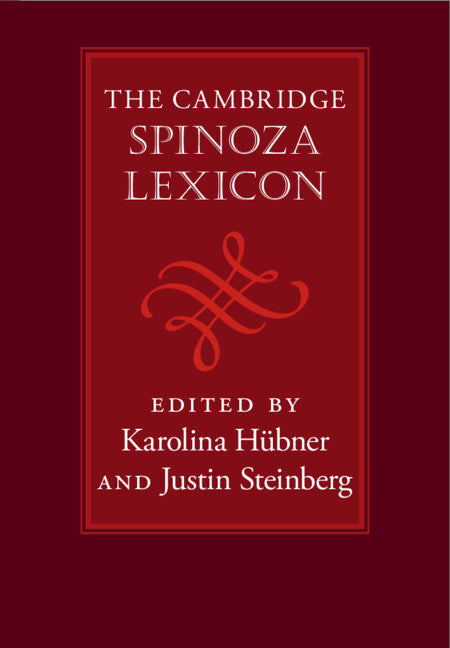
The Cambridge Spinoza Lexicon
A comprehensive guide to the thought of an influential and radical philosopher, composed by dozens of international experts.
Karolina Hübner (Edited by), Justin Steinberg (Edited by)
9781108834223, Cambridge University Press
Hardback, published 12 December 2024
644 pages
26.1 x 18.5 x 4.2 cm, 1.35 kg
'This volume … offers a comprehensive and in-depth perspective on all the notions, concepts, and sources, thus contributing to a thorough understanding of Spinoza's thought. It is a true tool for study and research, allowing readers to navigate the richness and complexity of Spinoza's work through a clear and precise presentation of each entry, which also includes systematic references to the influences exerted by Spinoza's philosophy. … It offers us the opportunity not only to delve into the richness of Spinoza's concepts but also to grasp their countless ramifications within modern and contemporary philosophy.' Saverio Ansaldi, Archives de philosophie
Baruch Spinoza is one of the most important and original thinkers of the modern period. His work inspired religious free-thinkers and political radicals, French Enlightenment philosophes, German Idealists, Russian Marxists, writers, and scientists. The Lexicon is a comprehensive compendium of entries on Spinoza's own concepts and associated historical figures. It cuts through the daunting profusion of Spinoza scholarship by supplying compact entries that contextualize Spinoza's thought, elucidate crucial concepts, and point the way to the relevant scholarly debates and studies. With entries by established and emerging scholars from North America, Australasia, and Europe, this is not only the most comprehensive and up-to-date picture of Spinoza scholarship, but also the most international and most diverse. It is a vital resource for novices and experts alike seeking to expand their knowledge of Spinoza.
List of contributors
About this Lexicon
List of Abbreviations of Spinoza's Works
1. Absolute (metaphysical) Antonio Salgado Borge
2. Absolute (political) Ericka Tucker
3. Abstractions and universals Karolina Hübner
4. Action and passion Chantal Jaquet
5. Adequacy Olli Koistinen
6. Affect Gwendolyn Marshall
7. Affection Syliane Malinowski-Charles
8. Affirmation Stephan Schmid
9. Agreement Andrea Sangiacomo
10. Ambition Jo Van Cauter and Eric Schliesser
11. Animals Martin Lenz
12. Animation Oberto Marrama
13. Apostle Mogens Lærke
14. Aristocracy Sandra Leonie Field
15. Attribute Noa Shein
16. Bacon, Francis Daniel Garber
17. Balling, Pieter Wiep van Bunge
18. Bayle, Pierre Todd Ryan
19. Belief Stephan Schmid
20. Blessedness Leonardo Moauro and Donald Rutherford
21. Blijenbergh, Willem van Moira Gatens
22. Body Galen Barry
23. Bondage Hasana Sharp
24. Bouwmeester, Johannes Piet Steenbakkers
25. Boxel, Hugo Wiep van Bunge
26. Boyle, Robert Stephen Harrop
27. Calvin and Calvinism Russ Leo
28. Causal axiom Alan Nelson
29. Cause Tad Schmaltz
30. Cause of itself Olli Koistinen
31. Certainty Syliane Malinowski-Charles
32. Charity Clare Carlisle
33. Cheerfulness Valtteri Viljanen
34. Christ Clare Carlisle
35. Citizen Sandra Leonie Field
36. Common notions Mogens Lærke
37. Compendium of the Grammar of the Hebrew Language (HG) Steven Nadler
38. Conception Martin Lin
39. Confusion Alan Nelson
40. Consciousness Michael LeBuffe
41. Contentment Sanem Soyarslan
42. de la Court, Pieter and Johan Jonathan Israel
43. Deleuze, Gilles Beth Lord
44. Democracy Ericka Tucker
45. Descartes, Rene Alan Nelson
46. Descartes's Principles of Philosophy (DPP) Steven Barbone
47. Desire Justin Steinberg
48. Determination Andrea Sangiacomo
49. Devotion Clare Carlisle
50. Dictates of reason Donald Rutherford
51. Diderot, Denis Jonathan Israel
52. Dutch Cartesianism Alexander Douglas
53. Education Julie Klein
54. Eliot, George Moira Gatens
55. Enden, Franciscus van den Frank Mertens
56. Equality Beth Lord
57. Essence Mogens Lærke
58. Esteem, love of Matthew Kisner
59. Eternity of mind Steven Nadler
60. Ethics Piet Steenbakkers
61. Existence Yitzhak Y. Melamed
62. Experience Pierre-François Moreau
63. Explicate John Carriero and Aaron West
64. Expression Robert Matyasi
65. Extension Galen Barry
66. Faith Martin Lin
67. Falsity and error Stephan Schmid
68. Feeling Kristin Primus
69. Fiction Moira Gatens
70. Follow Karolina Hübner
71. Form Christopher Martin
72. Fortitude Hasana Sharp
73. Fortune Martin Saar
74. Freedom (metaphysical) Olli Koistinen
75. Freedom (political) Justin Steinberg
76. Friendship Steven Nadler
77. Geometrical method Aaron Garrett
78. God Yitzhak Y. Melamed
79. Goethe, Johann Wolfgang von Valtteri Viljanen
80. Good and evil Steven Nadler
81. Graevius, Johannes Georgius Piet Steenbakkers
82. Grotius, Hugo Jon Miller
83. Hate Moira Gatens
84. Hebrew State Pierre-François Moreau
85. Herem Steven Nadler
86. Hobbes, Thomas Sandra Leonie Field
87. Hope and fear Donald Rutherford
88. Hudde, Johannes Eric Schliesser
89. Human nature Sarah Tropper
90. Idea Olli Koistinen
91. Ideas of ideas Kristin Primus
92. Idealist readings Karolina Hübner and Stephen Zylstra
93. Imagination Ursula Renz and Oliver Istvan Toth
94. Imitation of the affects Chantal Jaquet
95. Immanence Yitzhak Y. Melamed
96. Individual Tad Schmaltz
97. Infinite intellect Karolina Hübner and Josefine Klingspor
98. Infinite modes Kristin Primus
99. Infinity and finitude Noa Shein
100. Inherence John Carriero
101. Intuition Kristin Primus
102. Involvement Daniel Moerner
103. Islam Michael A. Rosenthal
104. Jelles, Jarig Wiep van Bunge
105. Joy Michael LeBuffe
106. Judaism Michael A. Rosenthal
107. Justice Johan Olsthoorn and Jo Van Cauter
108. Kabbalah Michael L. Morgan
1
Subject Areas: Western philosophy: c 1600 to c 1900 [HPCD]