Freshly Printed - allow 10 days lead
Couldn't load pickup availability
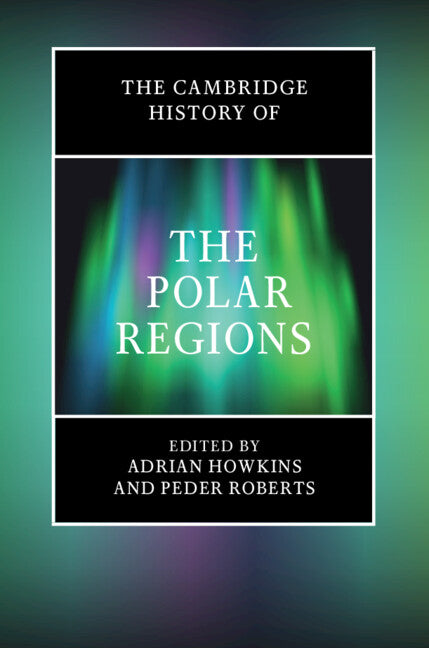
The Cambridge History of the Polar Regions
The first comprehensive reference work drawing together the history of both the Arctic and Antarctica from earliest times to present.
Adrian Howkins (Edited by), Peder Roberts (Edited by)
9781108429931, Cambridge University Press
Hardback, published 11 May 2023
850 pages
23.5 x 15.9 x 4.3 cm, 1.42 kg
'This Cambridge History is valuable for scholars of all stripes. Long-time polar specialists will find new insights, histories, and framings amid the comprehensive array of research across the chapters, while those more newly interested in engaging with the polar regions will get a thorough and well-informed introduction to the contemporary state of polar historiography.' Spencer Adams, H-Net
The Cambridge History of the Polar Regions is a landmark collection drawing together the history of the Arctic and Antarctica from the earliest times to the present. Structured as a series of thematic chapters, an international team of scholars offer a range of perspectives from environmental history, the history of science and exploration, cultural history, and the more traditional approaches of political, social, economic, and imperial history. The volume considers the centrality of Indigenous experience and the urgent need to build action in the present on a thorough understanding of the past. Using historical research based on methods ranging from archives and print culture to archaeology and oral histories, these essays provide fresh analyses of the discovery of Antarctica, the disappearance of Sir John Franklin, the fate of the Norse colony in Greenland, the origins of the Antarctic Treaty, and much more. This is an invaluable resource for anyone interested in the history of our planet.
1. Introduction Peder Roberts and Adrian Howkins
2. “I watch to see how the land is changing”: An Inuit perspective on changing environments and cultural resilience in the western Canadian Arctic George Angohiatok, Bryan Vandenbrink, Ian Hogg, and Thomas McIlwraith
3. The evolution of the Antarctic continent and its ice sheet Martin Siegert and Andrew Fountain
4. The initial peopling of the circumpolar north Bjarne Grønnow
5. Archaeology, politics, and Sámi heritage Carl-Gösta Ojala
6. The Norse settlement of Greenland Jette Arneborg
7. Russia, the first Arctic empire, 1000–1917 Ryan Tucker Jones, Alexei Kraikovski, and Julia Lajus
8. The discovery of Antarctica from Ptolemy to Shackleton Cornelia Lüdecke and Erki Tammiksaar
9. Sir John Franklin and the Northwest Passage in myth and memory Russell A. Potter
10. The heroic age of Antarctic exploration, 1890 to the present Stephanie Barczewski
11. Representing the polar regions through historical fiction Elizabeth Leane
12. Geography, anthropology, and Arctic knowledge-making Richard C. Powell
13. Britain's polar empire, 1769–1982 Daniella McCahey
14. Canada and the high Arctic islands, 1880–1950 Janice Cavell
15. The genesis of the Spitsbergen/Svalbard Treaty, 1871–1920 Roald Berg
16. Industrial whaling in the Arctic and Antarctic Bjørn L. Basberg and Louwrens Hacquebord
17. A historical archaeology of the first Antarctic labourers (ninteenth century) Melisa A. Salerno, M. Jimena Cruz, and Andrés Zarankin
18. Mining and colonialism in the circumpolar north Henrik Knudsen, Arn Keeling, and John Sandlos
19. Creating the Soviet Arctic, 1917–1991 Andy Bruno and Ekaterina Kalemeneva
20. Greenland: From colony to self-government, 1721–2021 Jens Heinrich
21. Cold War environmental knowledge in the polar regions Stephen Bocking and Pey-Yi Chu
22. The international geophysical year and the Antarctic treaty system Klaus Dodds
23. The first century of US militarization in Alaska, 1867–1967 Matthew Farish
24. Petroleum development and the state in Arctic North America, 1919–1977 Philip A. Wight
25. The rise of circumpolar political movements Mark Nuttall
26. The history of polar environmental governance Alessandro Antonello and Justiina Dahl
27. The Antarctic extension of Latin America Pablo Fontana
28. Moving muskoxen as an Arctic resource in the twentieth century Dolly Jørgensen
29. Boundaries of place and time at the edge of the polar oceans Hayley Brazier and Mark Carey
30. Restorying from within: Renewing relationships beyond the shadows of polar history Jackie Price, Rebecca Mearns, and Emilie Cameron
31. Conclusion Liza Piper and Lize-Marié van der Watt.
Subject Areas: History of science [PDX], Laws of Specific jurisdictions [LN], Historical geography [HBTP], General & world history [HBG]