Freshly Printed - allow 10 days lead
Couldn't load pickup availability
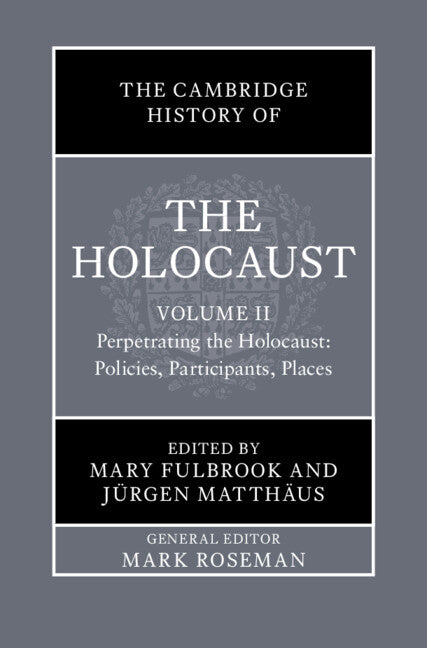
The Cambridge History of the Holocaust: Volume 2, Perpetrating The Holocaust: Policies, Participants, Places
A pan-European overview of Holocaust perpetration focusing on specific actors, structures and processes alongside wider themes and regions.
Mary Fulbrook (Edited by), Jürgen Matthäus (Edited by)
9781108839389, Cambridge University Press
Hardback, published 12 June 2025
608 pages
23.5 x 16.2 x 3.3 cm, 1.07 kg
'… the editors have assembled a truly international and intergenerational roster of contributors that reflects the vigor and breadth of the field and the diversity of the people who work in it. One particularly salutary consequence is that numerous chapters make a great deal of research in languages that are not usually accessible to English-speakers available to them … a compendium of multi-faceted and hard-won learning.' Peter Hayes, H-Soz-Kult
This ambitious pan-European overview explores the most significant causal factors, political developments, and societal forces that contributed to the perpetration of the Holocaust. Drawing on wide-ranging current scholarly expertise, this volume seeks to explain the genocidal scope and European dimensions of the crimes committed by Nazi Germany and its allies, collaborators, and facilitators across the continent during the war. It broadens the range of Holocaust research beyond the German initiators and organizers, however central these remain. Contributions look beyond simple or monocausal explanations in terms of, for example, Hitler's role or ideological antisemitism. Combining in-depth studies of specific locations and developments with overviews of thematic issues and wider questions, the second volume of the Cambridge History of the Holocaust offers concise analyses of the complex developments, varied interests, and interrelated events that were rooted in previous history and continue to influence the present within and beyond Europe. Cumulatively, this book presents a complex, multifaceted approach to understanding the uneven unfolding and escalation of the Holocaust.
Part I. Structures, Players, and Processes: 1. Hitler, the Nazi leadership and the evolution of the final solution Christopher Browning
2. The Nazi apparatus of terror: SS, SA, police Jochen Böhler
3. Bystanders, collaboration and complicity
4. Bystanders, collaboration and complicity Elizabeth Harvey
5. The German economy and the exploitation and extermination of the Jews Susanne Heim
6. The Wehrmacht, its allies, and 'partisan threats' Ben Shepherd
7. Gender and perpetration Elissa Mailänder
8. Perpetrator depictions of violence and the obliteration of evidence Valerie Hébert
9. Discourses, knowledge, and disbelief in the Reich and beyond Frank Bajohr and Felix Berge
10. 'Euthanasia', 'Germanization', and the beginnings of the Holocaust, 1939–1941 Isabel Heinemann
11. The personnel and functioning of the extermination camps Sara Berger and Donald Bloxham
Part II. Times and Places: 12. Ghettos and other confined spaces of Jewish life in Nazi-dominated Europe Dan Michmann
13. German and local violence in the Balkans Emil Kerenji
14. Forced migration, flight and refuge in the West Miriam Rürup
15. 'War of annihilation' in the occupied Soviet Union, 1941–1942 Edward Westermann
16. Neighbors and killing in the East Tomasz Frydel
17. 'Aktion Reinhardt' and the murder of the polish Jews Stephan Lehnstaedt
18. Collaboration in German-dominated western Europe Peter Romijn
19. Deportations from central and western Europe Birthe Kundrus and Jan Kreutz
20. Remaining Jewish spaces and their liquidation, 1942–1944 Tatjana Tönsmeyer
21. 'Operation Höss:' Auschwitz and the murder of the Hungarian Jews Gábor Kádár and Zoltán Vági
22. Death marches of camp inmates and German atrocities at the war's end Daniel Blatman
23. German agency and the Holocaust as a European project Jürgen Matthäus and Mary Fulbrook.
Subject Areas: European history [HBJD]