Freshly Printed - allow 10 days lead
Couldn't load pickup availability
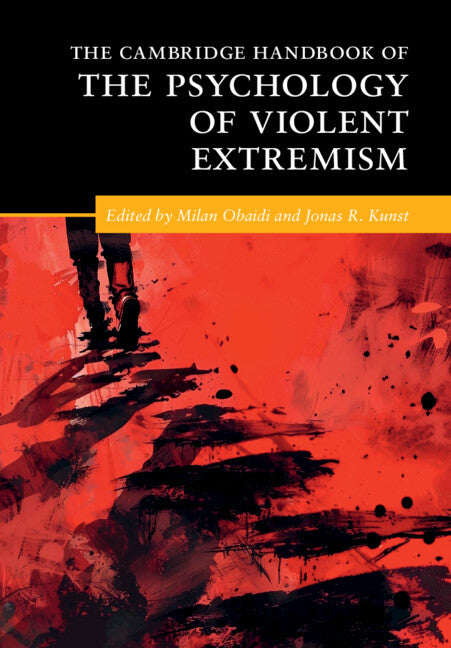
The Cambridge Handbook of the Psychology of Violent Extremism
The most comprehensive resource on psychological drivers of violent extremism, offering multi-level analyses and actionable insights.
Milan Obaidi (Edited by), Jonas Kunst (Edited by)
9781009407915, Cambridge University Press
Hardback, published 7 August 2025
524 pages
25.4 x 17.8 x 2.9 cm, 1.227 kg
Psychology, with its dedication to understanding human behavior and its complexities, is a key part in comprehending the underpinnings of violent extremism. This comprehensive resource encompasses all major psychological frameworks related to violent extremism, making it essential reading for scholars, practitioners, policymakers, and students determined to enact positive change in this critical area. This handbook provides a state-of-the-art overview of the psychological drivers of violent extremism, offering multi-level analyses that span individual, group, and contextual factors. Each chapter includes practical sections outlining implications for practitioners and policymakers, ensuring the theoretical insights are directly applicable to real-world scenarios. To clarify such complex concepts, the book is enriched with models and diagrams. By integrating diverse theoretical perspectives and empirical research, this guide provides invaluable insights and actionable strategies to effectively understand and combat violent extremism.
1. Introduction Jonas R. Kunst and Milan Obaidi
Part I. Concepts, Definitions and Trends: 2. Terrorism, radicalisation and [violent] extremism: concepts and definitions Alex P. Schmid
3. The future of violent extremism research – 5 recommendations based on a machine learning analysis of 34,000+ articles Jonas R. Kunst and Milan Obaidi
Part II. Individual-Level Perspectives: 4. Individual differences in violent extremism Milan Obaid, Robin Bergh and John F. Dovidio
5. Conceptualising diversity among violent extremists – a typology and a model for explaining change Tore Bjørgo
6. The role of gender in violent extremism Katrine Fangen and Inger Skjelsbækk
7. Quest for significance and violent extremism Erica Molinario, David Webber, Katarzyna Jasko and Arie Kruglanski
8. Religious fundamentalism and violent extremism Mirra Noor Milla and Whinda Yustisia
9. Conspiracy theories and violent extremism Kinga Bierwiaczonek, Jan-Willem van Prooijen, Sander van der Linden and Bettina Rottweiler
10. Violent extremism and the moral landscape Tore Wig and Milan Obaidi
11. Emotions in violent extremism Eran Halperin, Sidney Bode and Nicole Tausch
Part III. Group-Level Perspectives: 12. Social identity, self-uncertainty, and violent extremism Michael Hogg
13. The role of identity fusion in violent extremism Angel Gomez, Alexandra Vázquez, Laura Blanco and Juana Chinchilla
14. Devoted versus rational actors: radicalizing for extreme conflict and the will to fight Scott Atran
15. Political violence vs. violent extremism: a social dominance theory approach Felicia Pratto, Shana Levin, Aleksandra Rusowicz, J. N. Rasmus Möring and Anthony F. Lemieux
16. The role of relative deprivation in the process of radicalizaion into violent extremism Danny Osborne, Kieren J. Lilly, Jonas R. Kunst, Milan Obaidi and Kees van den Bos
17. Navigating the threat landscape: understanding the role of threat perceptions in violent extremism Milan Obaidi, Jonas R. Kunst and Kledian Myftari
18. The role of dehumanization in violent extremism Gordon Hodson and Nour Kteily
Part IV. Macro-Level Perspectives: 19. Inequality, poverty, and the staircase to terrorism: a 'societies to cells' approach to violent extremism Fathali Moghaddam, Kevin R. Carriere and Raimundo Salas-Schweikart
20. Foreign military interventions, occupations and violent extremism Piazza James
21. The psychological consequences of globalization and violent extremism Simon Ozer and Milan Obaidi
22. Climate and catalyst events and their intersection with violent extremism Nora C. Benningstad, Andreas Miles-Novelo, Jonas R. Kunst, Milan Obaidi and Craig A. Anderson
23. Temporal perspectives: understanding the psychology of violent extremism Ann-Cathrin Coenen and Seamus Power
24. Concluding remarks Jonas R. Kunst and Milan Obaidi.
Subject Areas: Social, group or collective psychology [JMH]