Special Order - allow 2+ weeks lead
Couldn't load pickup availability
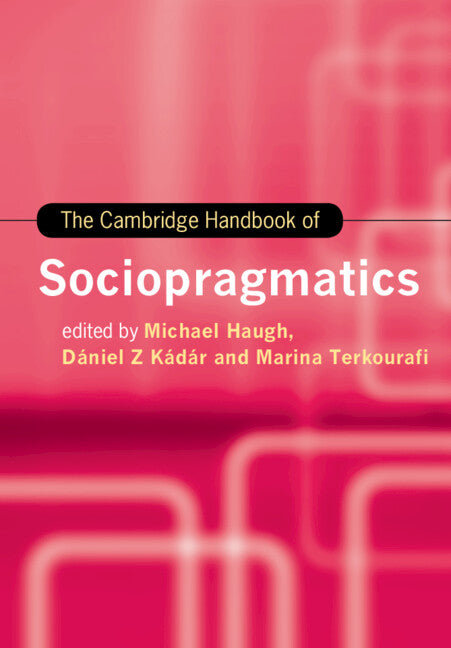
The Cambridge Handbook of Sociopragmatics
Written by leading experts in the field, this Handbook provides a systematic, cutting-edge introduction to the field of sociopragmatics.
Michael Haugh (Edited by), Dániel Z. Kádár (Edited by), Marina Terkourafi (Edited by)
9781108949309, Cambridge University Press
Paperback / softback, published 3 August 2023
797 pages
24.5 x 17 x 4.5 cm, 1.397 kg
Sociopragmatics is a rapidly growing field and this is the first ever handbook dedicated to this exciting area of study. Bringing together an international team of leading editors and contributors, it provides a comprehensive, cutting-edge overview of the key concepts, topics, settings and methodologies involved in sociopragmatic research. The chapters are organised in a systematic fashion, and span a wide range of theoretical research on how language communicates multiple meanings in context, how it influences our daily interactions and relationships with others, and how it helps construct our social worlds. Providing insight into a fascinating array of phenomena and novel research directions, the Handbook is not only relevant to experts of pragmatics but to any reader with an interest in language and its use in different contexts, including researchers in sociology, anthropology and communication, and students of applied linguistics and related areas, as well as professional practitioners in communication research.
1. Introduction: directions in sociopragmatics Michael Haugh, Dániel Z. Kádár and Marina Terkourafi
Part I. Fundamentals of Sociopragmatics: 2. Sociopragmatics: roots and definition Jonathan Culpeper
3. Inference and implicature Marina Terkourafi
4. Speaker meaning, commitment and accountability Chi-Hé Elder
5. Social actions Arnulf Deppermann
6. Stance and evaluation Maarit Siromaa and Mirka Rauniomaa
7. Reflexivity and meta-awareness Jef Verschueren
8. Participation and footing Elizabeth Holt and Jim O'Driscoll
9. Conventionalisation and conventions Dániel Z. Kádár and Juliane House
10. Synchronic and diachronic pragmatic variability Anne Barron
11. Activity types and genres Dawn Archer, Piotr Jagodziński and Rebecca Jagodziński
12. Social groups and relational networks Diana Boxer and Florencia Cortés-Conde
Part II. Topics and Settings in Sociopragmatics: 13. Face, facework and face-threatening acts Maria Sifianou and Angeliki Tzanne
14. Relationships and relating Robert Arundale
15. Analysing identity Pilar Garcés -Conejos Blitvich and Alexandra Georgakopoulou
16. (Im)politeness and sociopragmatics Jonathan Culpeper and Michael Haugh
17. Affect and emotion Laura Alba-Juez
18. Power Michiel Leezenberg
19. Morality in sociopragmatics Pilar Blitvich and Dániel Z. Kádár
20. Conversational humour Marta Dynel and Valeria Sinkeviciute
21. Gesture and prosody in multimodal communication Lucien Brown and Pilar Prieto
22. Digitally-mediated communication Chiaoqun Xie and Francisco Yus
23. Workplace and institutional discourse Meredith Marra and Shelley Dawson
24. Service encounter discourse J. César Félix-Brasdefer and Rosina Márquez-Reiter
25. Argumentative, political and legal discourse Anita Fetzer and Iwona Witczak-Plisiecka
26. The pragmatics of translation Juliane House
Part III. Approaches and Methods in Sociopragmatics: 27. Interpersonal pragmatics Miriam Locher and Sage Lambert Graham
28. Sociocognitive pragmatics Istvan Kecskes
29. Conversation analysis and sociopragmatics Rebecca Clift and Michael Haugh
30. Corpus pragmatics Svenja Adolphs and Yaoyao Chen
31. Variational pragmatics Klaus P. Schneider
32. Historical sociopragmatics Magdalena Leitner and Andreas H. Jucker
33. Emancipatory pragmatics Scott Saft, Sachiko Ide and Kishiko Ueno
34. Cross-cultural and intercultural pragmatics Troy McConachy and Helen Spencer-Oatey
35. Second-language pragmatics Elly Ifantidou.
Subject Areas: Semantics, discourse analysis, etc [CFG], Sociolinguistics [CFB], Linguistics [CF]