Freshly Printed - allow 10 days lead
Couldn't load pickup availability
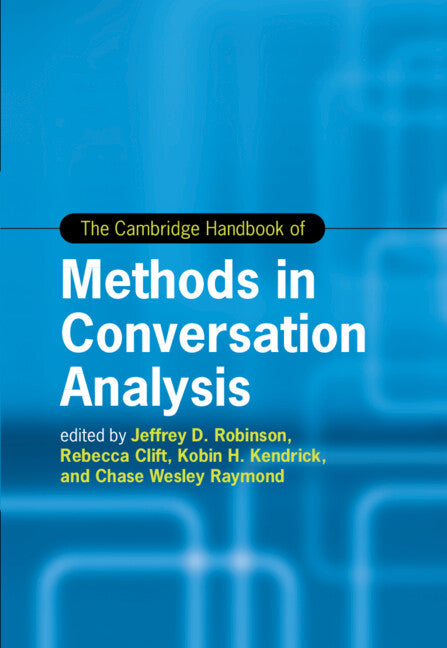
The Cambridge Handbook of Methods in Conversation Analysis
With contributions from world-renowned experts, this volume is the first to provide a complete overview of conversation-analytic methods.
Jeffrey D. Robinson (Edited by), Rebecca Clift (Edited by), Kobin H. Kendrick (Edited by), Chase Wesley Raymond (Edited by)
9781108837941, Cambridge University Press
Hardback, published 5 December 2024
1030 pages
25 x 17.5 x 6 cm, 1.86 kg
'This is not an orthodox handbook but a novel and practical research manual on how to do conversation analysis. It will provide practical steps that both students and scholars can apply to their research.' Gregory Matoesian, Professor, Department of Criminology, Law & Justice & Department of Linguistics, University of Illinois at Chicago
Conversation Analysis (CA) is one of the predominant methods for the detailed study of human social interaction. Bringing together thirty-four chapters written by a team of world-renowned experts, this Handbook represents the first comprehensive overview of conversation-analytic methods. Topics include how to collect, manage, and transcribe data; how to explore data in search of possible phenomena; how to form and develop collections of phenomena; how to use different types of evidence to analyze data; how to code and quantify interaction; and how to apply, publish, and communicate findings to those who stand to benefit from them. Each method is introduced clearly and systematically, and examples of CA in different languages and cultures are included, to show how it can be applied in multiple settings. Comprehensive yet accessible, it is essential reading for researchers and advanced students in disciplines such as Linguistics, Sociology, Anthropology, Communication and Psychology.
Part I. Introduction: 1. Methods in conversation analysis Chase Wesley Raymond, Rebecca Clift, Kobin H. Kendrick and Jeffrey D. Robinson
Part II. Points of Departure: 2. Conversation-analytic methods of data collection Elliott M. Hoey and Joseph C. Webb
3. Collecting interaction data in the 'lab' versus the 'field': rationale, ramifications, and recommendations Jeffrey D. Robinson
4. Working with data I: field recordings Saul Albert and Emily Hofstetter
5. Multimodal transcription as process and analysis: capturing the audible and visible Florence Oloff and Alexa Hepburn
6. Discovering a candidate phenomenon Rebecca Clift and Jenny Mandelbaum
7. Data Sessions Emma Betz
Part III. Collections: 8. Working with collections in conversation analysis Steven E. Clayman
9. Working with data II: clips and collections Emily Hofstetter and Saul Albert
10. History of a collection: repetition repairs Traci Walker
11. Developing a collection: apologies Paul Drew
12. Developing a collection: coordination of embodied conduct with darf/kann ich X? 'may/can I…?' in German Arnulf Deppermann and Alexandra Gubina
Part IV. Evidence: 13. Evidencing conversation-analytic claims: how participants orient to social action Chase Wesley Raymond and Jeffrey D. Robinson
14. Evidence for claims about interactants' sense-making processes Anita M. Pomerantz
15. Conversation analysis as a comparative methodology Paul Drew, Ana Cristina Ostermann and Chase Wesley Raymond
16. The epistemics of epistemics: validating claims about epistemic stance in conversation analysis John Heritage
17. Coding and statistically associating inter-action to advance conversation-analytic findings Jeffrey D. Robinson
Part V. Avenues into Action: 18. Single-case analysis Aug Nishizaka
19. Ethnomethodology, conversation analysis, and the study of interaction in everyday life Douglas W. Maynard and Virginia Teas Gill
20. Analyzing categorial phenomena in talk-in-interaction Kevin A. Whitehead, Geoffrey Raymond and Elizabeth Stokoe
21. Where the action is: positioning matters in interaction Danielle Pillet-Shore
22. Analyzing particles Galina B. Bolden
23. Analyzing grammar in social interaction Barbara Fox, Elizabeth Couper-Kuhlen, Barbara A. Fox, Chase Wesley Raymond, Marja-Leena Sorjonen and Sandra A. Thompson
24. Listening to talk-in-interaction: ways of observing speech Richard Ogden
25. Multimodality in conversation analysis Lorenza Mondada
26. System-oriented analysis: moving from singular practices to organizations of practice Kobin H. Kendrick
27. Comparing across languages and cultures Makoto Hayashi and Stephanie Hyeri Kim
28. Methodological considerations when using conversation analysis to investigate institutional interaction Merran Toerien
29. Methods for 'applying' conversation analysis Rebecca K. Barnes
30. Using conversation analytic research methods in the study of atypical populations Ray Wilkinson
Part VI. Situating and Reporting Findings: 31. CA across disciplines: connecting and engaging through publishing Rebecca Clift, Rod Gardner, Rose McCabe, Anssi Peräkylä and Jonathan Potter
32. What do journal editors look for in publishing CA work? Charles Antaki, Leelo Keevallik and Elwys de Stefani
33. Communicating findings to non-CA professionals Chloe Shaw
Part VII. Looking Forward: 34. Opening up avenues into action: future directions in conversation analysis Kobin H. Kendrick, Rebecca Clift, Chase Wesley Raymond and Jeffrey D. Robinson
Appendices: Appendix 1. Jeffersonian transcription conventions Rebecca Clift, Kobin H. Kendrick, Chase Wesley Raymond and Jeffrey D. Robinson
Appendix 2. Multimodal transcription conventions Lorenza Mondada.
Subject Areas: Semantics, discourse analysis, etc [CFG]