Freshly Printed - allow 10 days lead
Couldn't load pickup availability
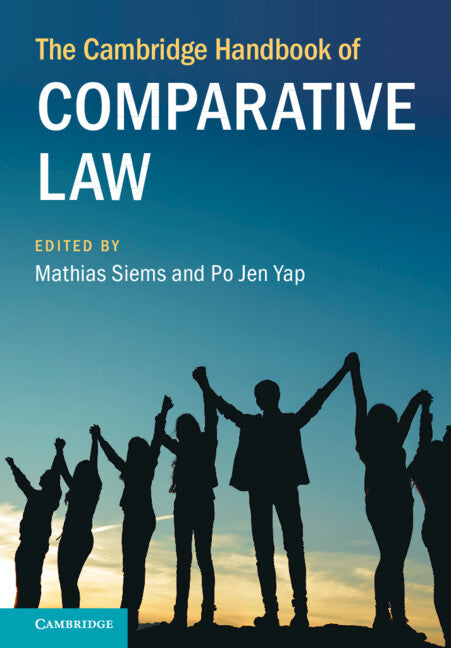
The Cambridge Handbook of Comparative Law
Presents a truly global perspective of comparative law today aiming to appeal to readers globally.
Mathias Siems (Edited by), Po Jen Yap (Edited by)
9781108843089, Cambridge University Press
Hardback, published 1 February 2024
780 pages, 19 b/w illus. 11 tables
26.2 x 18.5 x 4.7 cm, 1.65 kg
'This is a rich, innovative and expertly written handbook. The fundamental thrust of this book is a critical appraisal of comparative law from multiple perspectives, ranging from methodologies, legal families, key themes, to non-state-centric fields. The handbook achieves a quantum leap for comparative law scholarship and surely points an adventurous route for those who wish to embark on deeper inquiries.' Shen Wei, Distinguished Professor of Law at Shanghai Jiao Tong University Law School
Comparative law is a common subject-matter of research and teaching in many universities around the world, and the twenty-first century has aptly been termed 'the era of comparative law'. This Cambridge Handbook of Comparative Law presents a truly global perspective of comparative law today. The contributors are drawn from all parts of the world to provide different perspectives on how we understand the 'law' and how it operates in practice. In substance, the Handbook contains 36 chapters covering a broad range of topics, divided under the following headings: 'Methods of Comparative Law' (Part I), 'Legal Families and Geographical Comparisons' (Part II), 'Central Themes in Comparative Law' (Part III); and 'Comparative Law beyond the State' (Part IV).
1. Introduction: a new handbook for comparative law in a global context Mathias Siems and Po Jen Yap
Part I. Methods of Comparative Law: 2. Traditional methods Jaakko Husa
3. Historical-jurisprudential methods Jean-Louis Halpérin
4. Critical methods Thomas Coendet
5. Culture and comparative law methodology Qian Xiangyang
6. Linguistic approaches Łucja Biel
7. Qualitative fieldwork Petra Mahy, Richard Mitchell, John Howe, Ingrid Landau and Carolyn Sutherland
8. New institutional economics Olive Sabiiti
9. Empirical methods Mathias Siems
10. Machine-learning methods Han-wei Ho, Patrick Chung-Chia Huang and Yun-chien Chang
Part II. Legal Families and Geographical Comparisons: 11. Civil law Andrea Ortolani
12. Common law Shivprasad Swaminathan
13. Confucian legal tradition Ngoc Son Bui
14.Former Soviet States of Eastern Europe, Caucasus and Central Asia Andrey Shirvindt
15. Latin America Isabel Zuloaga and José Manuel Díaz de Valdés
16. Middle East and North Africa Radwa Elsaman
17. South Asia Rehan Abeyratne
18. Sub-Saharan Africa Charles Manga Fombad
Part III. Central Themes in Comparative Law: 19. The tradition of comparative law: comparison and its colonial legacies Helge Dedek
20. Decolonial theory and comparative law Roger Merino
21. Legal transplants: a theoretical framework and a case study from public law Margit Cohn
22. Legal transplants: a case study of private law in its historical context Gerardo Caffera, Rodrigo Momberg and María Elisa Morales
23. Convergence and divergence in public law Po Jen Yap
24. Convergence and divergence in company law Hatice Kübra Kandemir
25. Law and development Yong-Shik Lee and Andrew Harding
26. Divided legal systems: understanding legal systems in conflict-prone societies M. Bashir Mobasher and Haroun Rahimi
27. Legal pluralism and commerce Ada Ordor, Nojeem Amodu and Victor Amadi
Part IV. Comparative Law Beyond the State: 28. Comparative international law Danielle Hanna Rached and Conrado Hubner Mendes
29. Transnational regulation Victor V. Ramraj
30. Quantitative forms of legal governance Rene Urueña
31. Comparative international arbitration law Shahla Ali
32. Cross-border judicial dialogue Tom Gerald Daly
33. Comparing regional law Armin Cuyvers
34. Comparative conflict of laws Yuko Nishitani
35. Comparative indigenous law Anthony C. Diala
36. Comparative legal education Tan Cheng-Han, Alan Koh, Topo Santoso, Umakanth Varottil and Jiangyu Wang.
Subject Areas: Comparative law [LAM]