Freshly Printed - allow 10 days lead
Couldn't load pickup availability
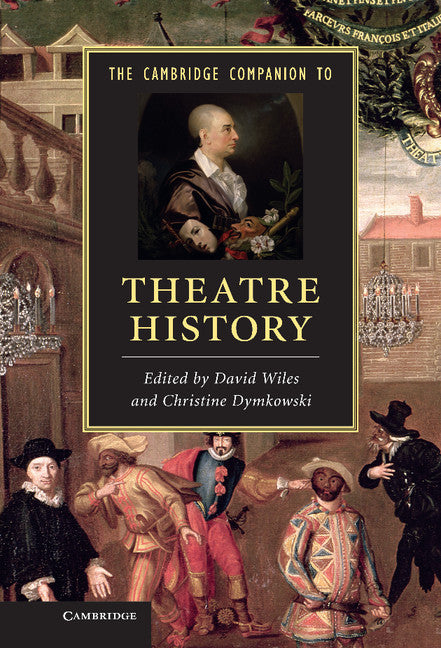
The Cambridge Companion to Theatre History
A wide-ranging set of essays that explain what theatre history is and why we need to engage with it.
David Wiles (Edited by), Christine Dymkowski (Edited by)
9780521766364, Cambridge University Press
Hardback, published 13 December 2012
340 pages, 36 b/w illus.
23.1 x 15.2 x 2 cm, 0.66 kg
'Seasoned scholars and students alike will find much of value in this diverse collection. Highly recommended.' J. Fisher, Choice
Scholars, amateur historians and actors have shaped theatre history in different ways at different times and in different places. This Companion offers students and general readers a series of accessible and engaging essays on the key aspects of studying and writing theatre history. The diverse international team of contributors investigates how theatre history has been constructed, showing how historical facts are tied to political and artistic agendas and explaining why history matters to us. Beginning with an introduction to the central narrative that traditionally informs our understanding of what theatre is, the book then turns to alternative points of view - from other parts of the world and from the perspective of performers in fields such as music-theatre and circus. It concludes by looking at how history is written in the 'democratic' age of the Internet and offers a new perspective on theatre history in our globalised world.
Introduction: why?
1. Why theatre history? David Wiles
Part I. When?: Indicative Timeline: 2. Modernist theatre Stefan Hulfeld
3. Baroque to romantic theatre Christopher Baugh
4. Medieval, renaissance and early modern theatre David Wiles
5. Classical theatre Erika Fischer-Lichte
Part II. Where?: 6. Liverpool Ros Merkin
7. Finland S. E. Wilmer
8. Egypt Hazem Azmy
9. Traditional theatre: the case of Japanese Noh Diego Pellecchia
10. Reflections on a global theatre history Marvin Carlson
Part III. What?: 11. The audience Willmar Sauter
12. The art of acting Josette Féral
13. Music theatre and musical theatre Zachary Dunbar
14. Circus Marius Kwint
Part IV. How?: 15. The nature of historical evidence: a case study Thomas Postlewait
16. The visual record: the case of Hamlet Barbara Hodgdon
17. Museums, archives and collecting Fiona Macintosh
18. Re:enactment Gilli Bush-Bailey
19. The internet: history 2.0? Jacky Bratton and Grant Tyler Peterson.
Subject Areas: Theatre studies [AN]