Freshly Printed - allow 10 days lead
Couldn't load pickup availability
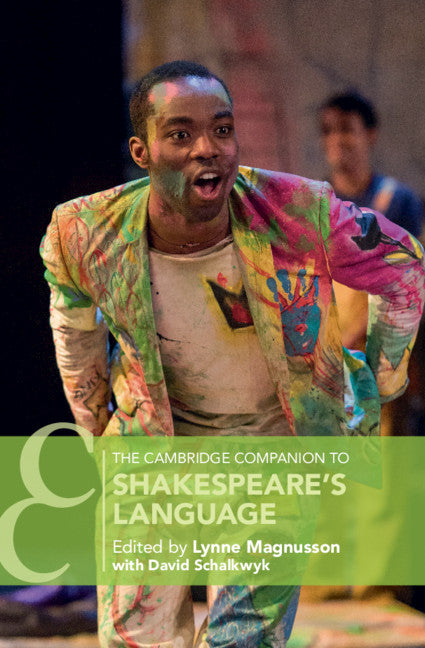
The Cambridge Companion to Shakespeare's Language
Illuminates the pleasures and challenges of Shakespeare's complex language for today's students, teachers, actors and theatre-goers.
Lynne Magnusson (Edited by), David Schalkwyk (Edited by)
9781107131934, Cambridge University Press
Hardback, published 8 August 2019
310 pages, 2 b/w illus. 2 tables
23.5 x 15.7 x 1.9 cm, 0.61 kg
'Even though the volume is primarily intended for students of Shakespeare, it is no less suited for teachers, theatre professionals, and researchers who seek innovative ways to mine the richness of Shakespeare's language … What admirably binds these essays together is their careful scrutiny of the vital work that language does - what Shakespeare does with language and what the language of Shakespeare's time does to him, and what we do with Shakespeare's language and what this language does to us, in turn.' Jelena Marelj, Renaissance et Réforme
The power of Shakespeare's complex language - his linguistic playfulness, poetic diction and dramatic dialogue - inspires and challenges students, teachers, actors and theatre-goers across the globe. It has iconic status and enormous resonance, even as language change and the distance of time render it more opaque and difficult. The Cambridge Companion to Shakespeare's Language provides important contexts for understanding Shakespeare's experiments with language and offers accessible approaches to engaging with it directly and pleasurably. Incorporating both practical analysis and exemplary readings of Shakespearean passages, it covers elements of style, metre, speech action and dialogue; examines the shaping contexts of rhetorical education and social language; test-drives newly available digital methodologies and technologies; and considers Shakespeare's language in relation to performance, translation and popular culture. The Companion explains the present state of understanding while identifying opportunities for fresh discovery, leaving students equipped to ask productive questions and try out innovative methods.
Part I. Basic Elements: 1. Shakespeare and the problem of style Jeff Dolven
2. Shakespeare's creativity with words Alysia Kolentsis
3. The performative power of Shakespeare's language David Schalkwyk
4. Verse and metre Oliver Morgan
5. The dynamics of Shakespearean dialogue Lynne Magnusson
6. Figures of speech at work Ruth Morse
Part II. Shaping Contexts: 7. Approaching Shakespeare through rhetoric Peter Mack
8. Shakespeare and social languages James Siemon
Part III. New Technologies: 9. Digital approaches to Shakespeare's language Jonathan Hope
10. Authorship, computers, and comparative style Hugh Craig
11. Reading in time: cognitive dynamics and the literary experience of Shakespeare Amy Cook and Seth Frey
Part IV. Contemporary Sites for Language Change: 12. Writing for actors: language that cues performance Carol Chillington Rutter
13. Language and translation Dirk Delabastita
14. Popular culture and Shakespeare's language Douglas M. Lanier.
Subject Areas: Literary companions, book reviews & guides [DSRC], Shakespeare studies & criticism [DSGS]