Freshly Printed - allow 6 days lead
Couldn't load pickup availability
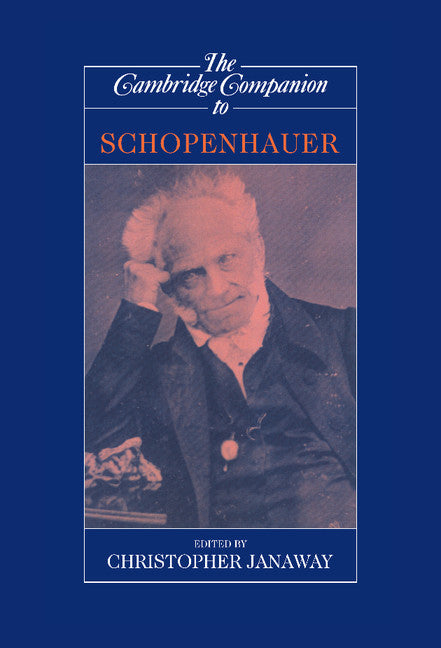
The Cambridge Companion to Schopenhauer
A collection of specially-commissioned essays analysing Schopenhauer's philosophy.
Christopher Janaway (Edited by)
9780521621069, Cambridge University Press
Hardback, published 13 October 1999
494 pages
23.6 x 15.8 x 3.5 cm, 0.81 kg
"Exposing the deep flaws as well as the merits of Schopenhauer's work, the text offers a valuable contribution to its understanding, while charitably passing over his renowned and unfortunate prejudices." The Review of Metaphysics
Arthur Schopenhauer (1788–1860) is something of a maverick figure in the history of philosophy. He produced a unique theory of the world and human existence based upon his notion of will. This collection analyses the related but distinct components of will from the point of view of epistemology, metaphysics, philosophy of mind, aesthetics, ethics, and the philosophy of psychoanalysis. This volume explores Schopenhauer's philosophy of death, his relationship to the philosophy of Kant, his use of ideas drawn from both Buddhism and Hinduism, and the important influence he exerted on Nietzsche, Freud, and Wittgenstein.
Introduction Christopher Janaway
1. Schopenhauer on the self Günter Zöller
2. Schopenhauer and knowledge David Hamlyn
3. The fourfold root Frank C. White
4. Schopenhauer, Kant, and the methods of philosophy Paul Guyer
5. Will and nature Christopher Janaway
6. The influences of Eastern thought on Schopenhauer's Doctrine of the Thing in Itself Moira Nicholls
7. Ideas and imagination: Schopenhauer on the proper foundation of art Cheryl Foster
8. Schopenhauer's narrower sense of morality David E. Cartwright
9. Schopenhauer on death Dale Jacquette
10. Schopenhauer's pessimism Christopher Janaway
11. Nietzsche, Schopenhauer and Dionysus Martha C. Nussbaum
12. Schopenhauer, will, and the unconscious Sebastian Gardner
13. Schopenhauer and Wittgenstein: representation as language and will Hans-Johann Glock.
Subject Areas: Western philosophy: c 1600 to c 1900 [HPCD]