Freshly Printed - allow 8 days lead
Couldn't load pickup availability
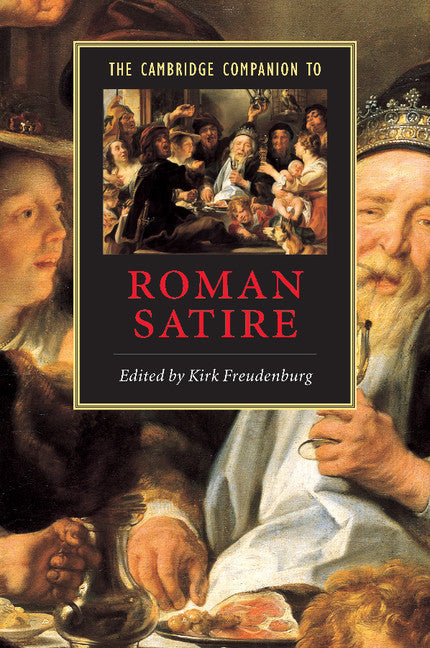
The Cambridge Companion to Roman Satire
Explores the development of Roman satire in antiquity and of its reception in later centuries.
Kirk Freudenburg (Edited by)
9780521006279, Cambridge University Press
Paperback, published 12 May 2005
374 pages, 1 b/w illus.
22.9 x 15.3 x 2.4 cm, 0.589 kg
'… the editor and the contributors to this volume while reaching for the star do not underestimate the difficulty of reading Roman satire and this is one of the main strengths of the book. Lector intende: this companion will delight you on your journey.' Classics Ireland
Satire as a distinct genre of writing was first developed by the Romans in the second century BCE. Regarded by them as uniquely 'their own', satire held a special place in the Roman imagination as the one genre that could address the problems of city life from the perspective of a 'real Roman'. In this Cambridge Companion an international team of scholars provides a stimulating introduction to Roman satire's core practitioners and practices, placing them within the contexts of Greco-Roman literary and political history. Besides addressing basic questions of authors, content, and form, the volume looks to the question of what satire 'does' within the world of Greco-Roman social exchanges, and goes on to treat the genre's further development, reception, and translation in Elizabethan England and beyond. Included are studies of the prosimetric, 'Menippean' satires that would become the models of Rabelais, Erasmus, More, and (narrative satire's crowning jewel) Swift.
Introduction: posing for the companion: Roman satire Kirk Freudenburg
Part I. Satire as Literature: 1. Rome's first 'satirists': themes and genre in Ennius and Lucilius Frances Muecke
2. The restless companion: Horace, Satires 1 and 2 Emily Gowers
3. Speaking from silence: the Stoic paradoxes of Persius Andrea Cucchiarelli
4. The poor man's feast: Juvenal Victoria Rimell
5. Citation and authority in Seneca's Apocolocyntosis Ellen O'Gorman
6. Late arrivals: Julian and Boethius Joel Relihan
7. From turnips to turbot: epic allusion in Roman satire Catherine Connors
8. Sleeping with the enemy: satire and philosophy Roland Mayer
9. The satiric maze: Petronius, satire and the novel Victoria Rimell
Part II. Satire as Social Discourse: 10. Satire as aristocratic play Thomas Habinek
11. Satire in a ritual context Fritz Graf
12. Satire and the poet: the body as self-referential symbol Alessandro Barchiesi and Andrea Cucchiarelli
13. The libidinal rhetoric of satire Erik Gunderson
14. Roman satire in the sixteenth century Colin Burrow
15. Alluding to satire: Rochester, Dryden, and others Dan Hooley
16. The Horatian and the Juvenalesque in English letters Charles Martindale
17. The 'presence' of Roman satire: modern receptions and their interpretative implications Duncan Kennedy
Conclusion. The turnaround: a volume retrospect on Roman satires John Henderson.
Subject Areas: Literary studies: classical, early & medieval [DSBB]