Freshly Printed - allow 10 days lead
Couldn't load pickup availability
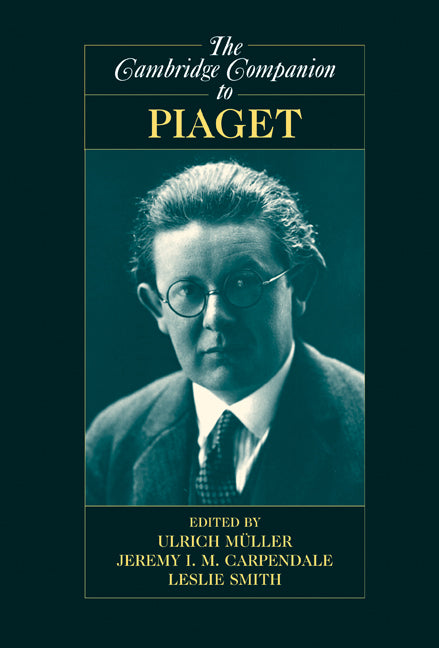
The Cambridge Companion to Piaget
The Cambridge Companion to Piaget provides a comprehensive introduction to different aspects of Jean Piaget's work.
Ulrich Müller (Edited by), Jeremy I. M. Carpendale (Edited by), Leslie Smith (Edited by)
9780521727198, Cambridge University Press
Paperback / softback, published 24 August 2009
440 pages, 11 b/w illus. 10 tables
22.9 x 15.4 x 2.4 cm, 0.58 kg
"....On the whole, even those chapters dealing with theoretically difficult aspects of Piaget's epistemology are well explained and clear. This makes this volume both an essential addition to the scholar's bookshelf as well as an ideal source of readings on Piaget's ideas for the advance student. Make no mistake: The picture of a young Piaget on the book cover sends the message that his developmental theory continues to be among the most comprehensive to date and that great many possibilities remain to be generated by his groundbreaking ideas."
--Dr. Diane Poulin-Dubois, Concordia University, Canadian Psychology/Psychologie Canadienne
Jean Piaget (1896–1980) was listed among the 100 most important persons in the twentieth century by Time magazine, and his work - with its distinctive account of human development - has had a tremendous influence on a range of disciplines from philosophy to education, and notably in developmental psychology. The Cambridge Companion to Piaget provides a comprehensive introduction to different aspects of Piaget's work in a manner that does not eschew engagement with the complexities of subjects or debates yet is accessible to upper-level undergraduate students. Each chapter is a specially commissioned essay written by an expert on the subject matter. Thus, the book will also be of interest to academic psychologists, educational psychologists, and philosophers.
1. Introduction: overview Ulrich Müller, Jeremy I. M. Carpendale, and Leslie Smith
2. The historical context of Piaget's ideas Maryléne Bennour and Jacques Vonéche
3. Piaget's developmental epistemology Leslie Smith
4. Piaget's biology John G. Messerly
5. On the concept(s) of the social in Piaget Richard F. Kitchener
6. Piaget on equilibration Jan Boom
7. Constructive processes: abstraction, generalization, and dialectics Robert L. Campbell
8. Piaget and method Trevor Bond and Anastasia Tryphon
9. Infancy Ulrich Müller
10. Childhood Maximilian B. Bibok, Ulrich Müller, and Jeremy I. M. Carpendale
11. Adolescence David Moshman
12. Piaget's theory of moral development Jeremy I. M. Carpendale
13. Piaget's enduring contribution to a science of consciousness Michel Ferrari
14. Piaget and affectivity Bryan W. Sokol and Stuart I. Hammond
15. Piaget's pedagogy Leslie Smith
16. Piaget in the United States, 1925–71 Yeh Hsueh
17. The mind's staircase revised Thomas Kesselring
18. Dynamic development: a neo-Piagetian approach L. Todd Rose and Kurt W. Fischer.
Subject Areas: Cognition & cognitive psychology [JMR], Psychology [JM]