Freshly Printed - allow 10 days lead
Couldn't load pickup availability
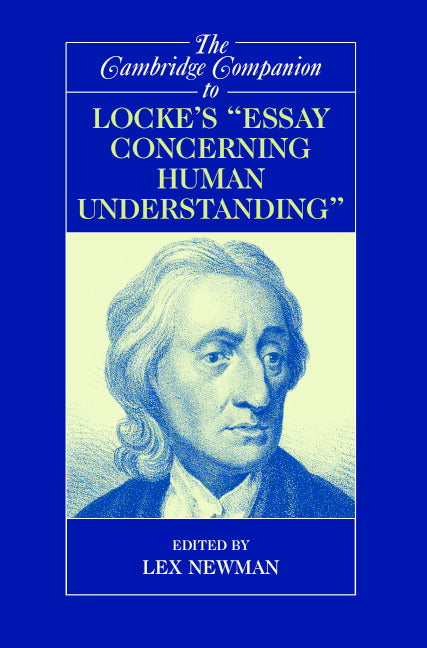
The Cambridge Companion to Locke's 'Essay Concerning Human Understanding'
Includes fifteen new essays from leading scholars, covering the major themes of Locke's work.
Lex Newman (Edited by)
9780521542258, Cambridge University Press
Paperback / softback, published 5 March 2007
502 pages
23 x 15.3 x 3.2 cm, 0.669 kg
'This is not only an immensely valuable and stimulating collection of essays, but also a beautifully edited and produced one, with an elegant and readable typeface, no typographical errors, and a very extensive bibliography. All Locke specialists should possess a copy and all teachers of Locke should include it on their students' reading lists.' Locke Studies
First published in 1689, John Locke's Essay Concerning Human Understanding is widely recognised as among the greatest works in the history of Western philosophy. The Essay puts forward a systematic empiricist theory of mind, detailing how all ideas and knowledge arise from sense experience. Locke was trained in mechanical philosophy and he crafted his account to be consistent with the best natural science of his day. The Essay was highly influential and its rendering of empiricism would become the standard for subsequent theorists. This Companion volume includes fifteen new essays from leading scholars. Covering the major themes of Locke's work, they explain his views while situating the ideas in the historical context of Locke's day and often clarifying their relationship to ongoing work in philosophy. Pitched to advanced undergraduates and graduate students, it is ideal for use in courses on early modern philosophy, British empiricism and John Locke.
Introduction Lex Newman
1. The intellectual setting and aims of the Essay G. A. J. Rogers
2. Locke's polemic against nativism Samuel C. Rickless
3. The taxonomy of ideas in Locke's Essay Martha Brandt Bolton
4. Locke's distinctions between primary and secondary qualities Michael Jacovides
5. Power in Locke's Essay Vere Chappell
6. Locke on substance Edwin McCann
7. Locke on ideas of identity and diversity Gideon Yaffe
8. Locke on ideas and representation Thomas M. Lennon
9. Locke on essences and classification Margaret Atherton
10. Language, meaning, and mind in Locke's Essay Michael Losonsky
11. Locke on knowledge Lex Newman
12. Locke's ontology Lisa Downing
13. The moral epistemology of Locke's Essay Catherine Wilson
14. Locke on judgment David Owen
15. Locke on faith and reason Nicholas Jolley.
Subject Areas: Philosophy: epistemology & theory of knowledge [HPK], History of Western philosophy [HPC], Philosophy [HP]